Hotel SEO
The Five GBP Levers That Actually Move Hotel Rankings (And the Ten Things That Don't)
Abstract
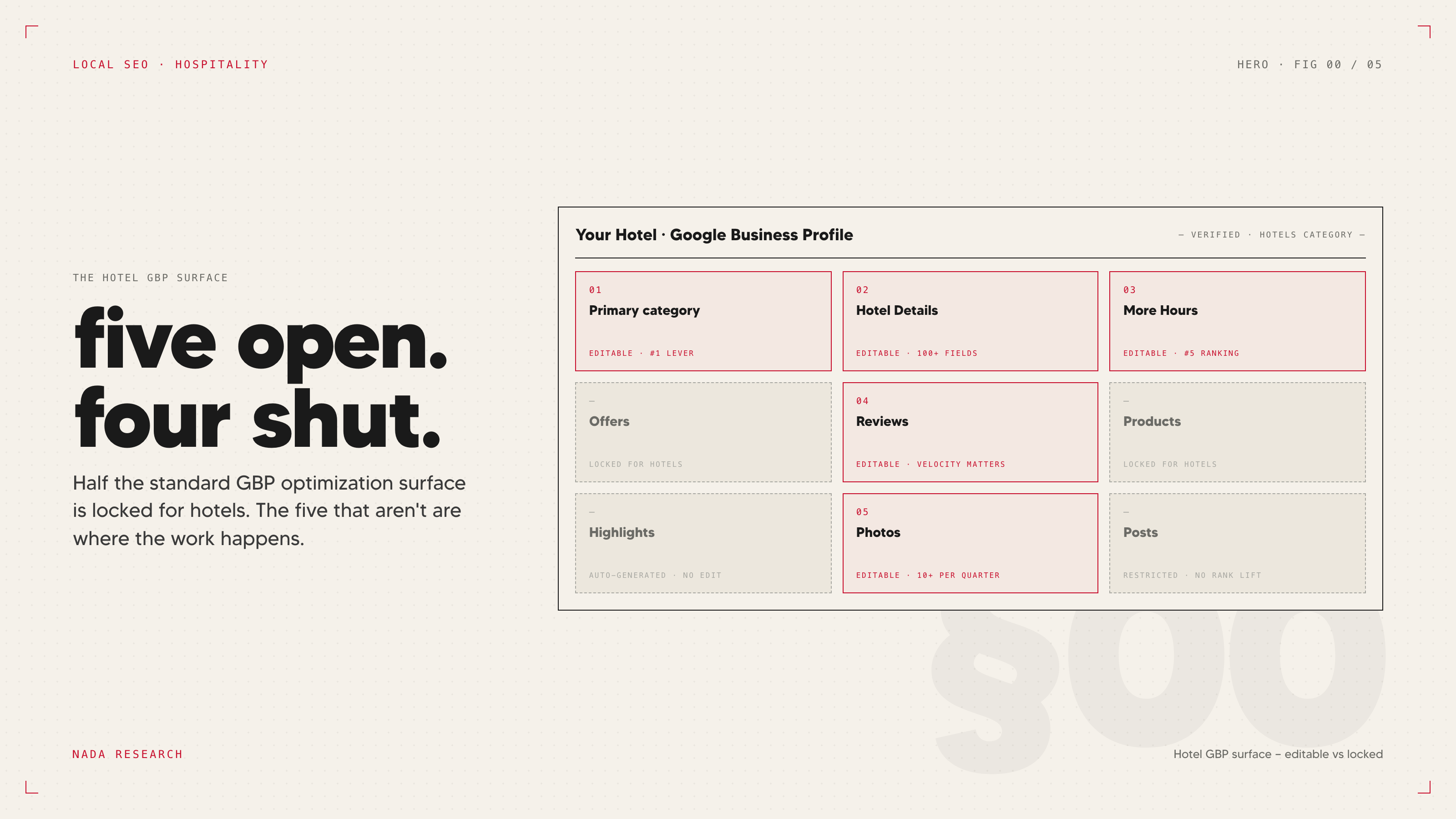
Hotel Google Business Profiles operate on the most restricted surface of any business category — Google locks Offers, Products, promotional Posts, and most of the knowledge panel for lodging. The five levers that actually move rankings are primary category, Hotel Details attributes, More Hours fields, reviews, and photos. Almost every other widely-recommended tactic — weekly Posts, geotagged photos, review-text keywords, 100+ directory citations — has been disproven by controlled testing from Sterling Sky, Whitespark, and former Google local search team members. This post covers all five levers in detail, then names the ten tactics to stop using.
There are two numbers that tell the whole story of an independent hotel's Google Business Profile. Google offers more than 90 Hotel Details attributes — covering amenities, sustainability, accessibility, food and drink, policies, parking, pets, room features, the works. The median independent has explicitly set somewhere around 15. The rest are populated by whichever OTA — Booking.com, Expedia, Hotels.com — got there first, and they're often outdated, sometimes contradictory, and occasionally wrong about whether the property has a pool.
That gap is the post in miniature. Hotels operate on the most restricted GBP surface of any business category, and the levers that do work are nearly all under-set or set wrong by default. The good news is the list is short. The bad news is most of the tactical advice in circulation — post weekly, geotag your photos, ask reviewers to mention specific amenities — has been controlled-tested and found to do nothing. We'll get to that. First, the levers that work.
Why your GBP has fewer levers than you've been told
The structural framing is in the Hotel Pack vs. Local Pack pillar, but the short version is this: hotels can't run Offers. Can't add Products. Posts are restricted to informational content with no promotional language, and even then they don't move rankings. There's no booking button on the profile header unless the property is integrated with Google's Hotel Ads program through a connectivity partner. Highlights aren't editable. Half the GBP optimization checklist published for "every business" simply doesn't apply.
Before you spend a minute on any of the levers below, run one check: search Google Maps for the property's street address. Legacy GBP listings from previous owners, prior management companies, or old franchise affiliations are the #1 cause of hotel GBP issues we encounter, and they're usually visible from a single address-search. Duplicates split your reviews, dilute your authority signals, and sometimes outrank the live profile. Identify them now; merge or report them through the GBP backend before tuning anything else.
What's left, in order of leverage, is five things. Each of them has a specific tactical move; together they account for almost all the controllable ranking surface a hotel has on this platform.
Lever 1 — Primary category: the highest-leverage single decision you make on this platform
Primary category is the single highest-impact field on a hotel GBP. It's the most influential relevance signal for local pack and Hotel Pack visibility, and it filters you in or out of every category-modified search a traveler runs ("boutique hotel," "inn near me," "resort"). The tactical move is to verify it monthly and set secondary categories that match your real revenue lines.
Primary GBP category is the single most influential relevance signal for local pack and Hotel Pack visibility, per the Whitespark 2026 Local Search Ranking Factors survey. Category changes can move rankings within days — faster than almost any other intervention available to a hotel marketer. The intervention takes about thirty seconds. The audit takes longer.
Google offers at least 12 distinct lodging categories. Hotel. Boutique Hotel. Resort Hotel. Bed & Breakfast. Inn. Motel. Extended Stay Hotel. Hostel. Holiday Park (Australia, New Zealand, EU only). Japanese Inn / Ryokan (Japan only). Plus regional and edge-case categories. Each one filters into a different traveler-search behavior. A guest searching "boutique hotel Austin" is filtering you out of their results if you're set as Hotel. A guest searching "inn near [landmark]" is filtering you out if you're set as Bed & Breakfast.
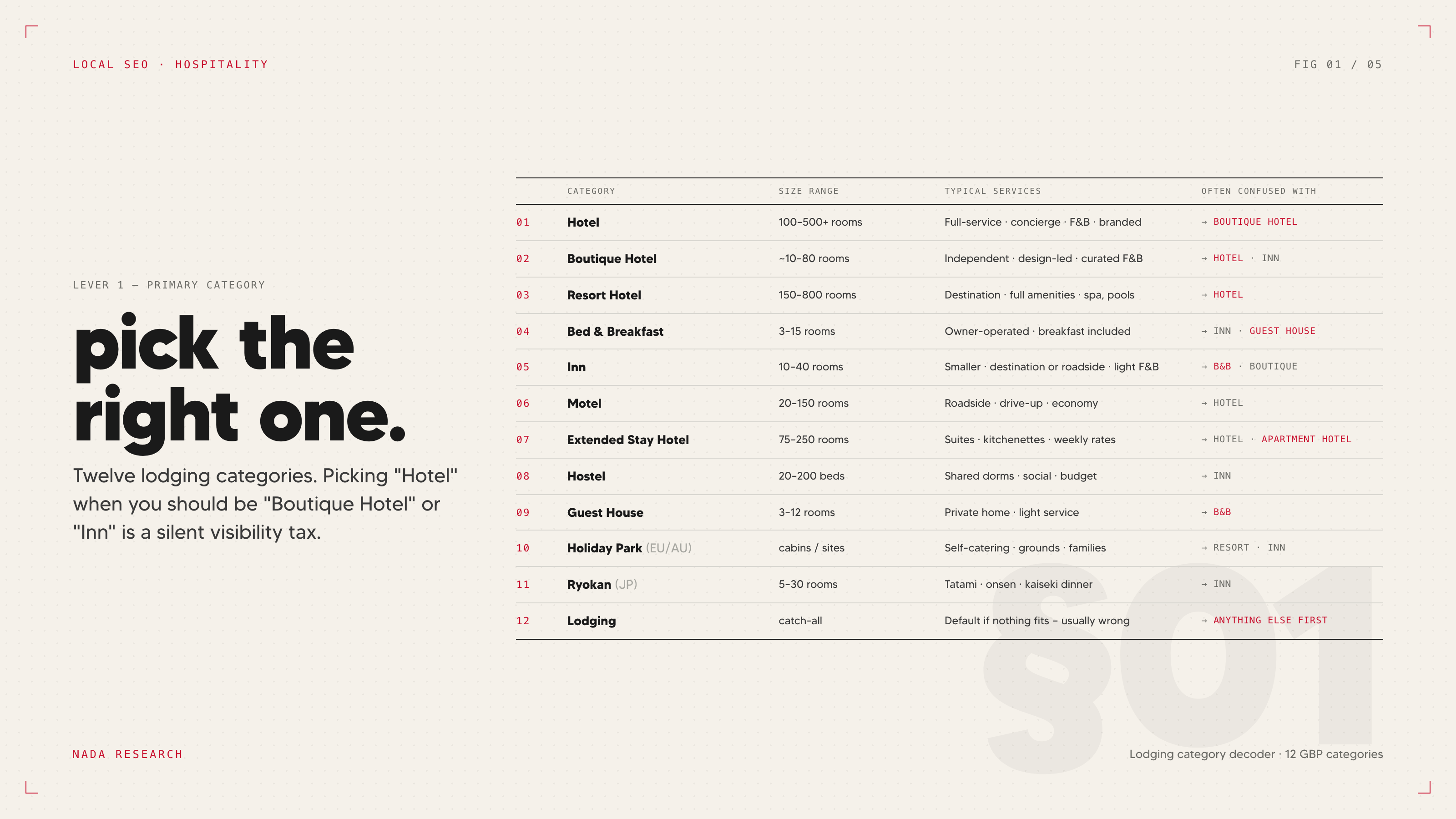
Here's how the categories actually map to property types in practice — what to pick, and what they're commonly confused with:
Hotel is the right call for most properties of 50+ rooms with full-service operations: front desk, daily housekeeping, on-site food and beverage. If you're a 200-room independent in a city center with a restaurant and a fitness center, you are a Hotel.
Boutique Hotel is for design-forward, smaller properties (typically under 100 rooms, often under 50) where the design and service style — not the room count alone — is the defining feature. The mistake here is two-directional. Some 30-room independents pick "Hotel" out of formality and miss every "boutique hotel" search. Some 280-room properties pick "Boutique Hotel" because they like the brand connotation, which is a category misalignment that Google may eventually correct on its own based on the services it sees.
Inn is typically historic, smaller (under 50 rooms), often includes breakfast, and sits in a non-urban or small-town context. Commonly confused with Bed & Breakfast.
Bed & Breakfast is typically single-family-owned, residential in feel, with the owner often on-site. The B&B label carries a specific guest expectation; if you don't meet it, the category mismatch will hurt conversion even if you rank.
Resort Hotel belongs to properties whose primary positioning is leisure-and-amenity: pool, spa, golf, beach, ski. A 120-key urban hotel with a small spa is not a Resort Hotel. A 60-key coastal property whose entire pitch is the location and the wellness offer is.
Extended Stay Hotel is a distinct category and worth picking accurately if you actually operate one — extended-stay searchers are a different segment with different intent.
The most useful thing Google has ever published on this question is the line in their Hotel Center documentation: "The name of your business doesn't affect your lodging category. A business named 'Main Street Hotel' might be properly classified as an inn or a bed and breakfast rather than a hotel, depending on the services it offers." Google classifies on signals — services, amenities, room count, what the OTAs are saying about you — not on the noun in your business name. This means two things. One: you don't have to fight Google's auto-classification by stuffing keywords into your name (and after the 2021 Vicinity update, that fight was over anyway — keyword-stuffed names got de-weighted). Two: category drift is a real maintenance issue. Google can change your primary category based on shifting signals, and they don't always tell you. Verify it monthly.
Up to nine secondary categories can be added, and they expand the query set you're eligible to appear for. For a hotel with a meaningful event business, "Wedding Venue" and "Event Venue" are worth setting. For a property with a destination-grade restaurant or spa, the category may be better served as a separate "located in" GBP listing, which gives you additional ranking real estate in the Local Pack for restaurant or spa queries. That's a Tim Capper recommendation worth taking seriously for properties where the on-site business is genuinely competitive on its own.
Lever 2 — Hotel Details: the 90-minute audit nobody is doing
Hotel Details attributes are the primary relevance signal for amenity-modified queries — pet-friendly, accessibility, EV charging, sustainability filters. They're populated by OTAs by default and almost never reflect the property accurately. The tactical move is a 90-minute manual audit of every attribute category in the GBP backend, set what applies, unset what doesn't.
Hotel Details attributes are the primary relevance signal for amenity-modified queries — the queries that, post-Vicinity, are where independents actually compete (the full keyword strategy lives in hotel keyword strategy). They're also populated by OTAs by default, which is the part most hoteliers don't realize. Until someone manually overrides them in the GBP backend, your attribute set reflects whatever Booking.com or Expedia is sending Google about you, which may be three years old, may have been imported from a competitor's listing during a data error, and may include amenities the property no longer offers.
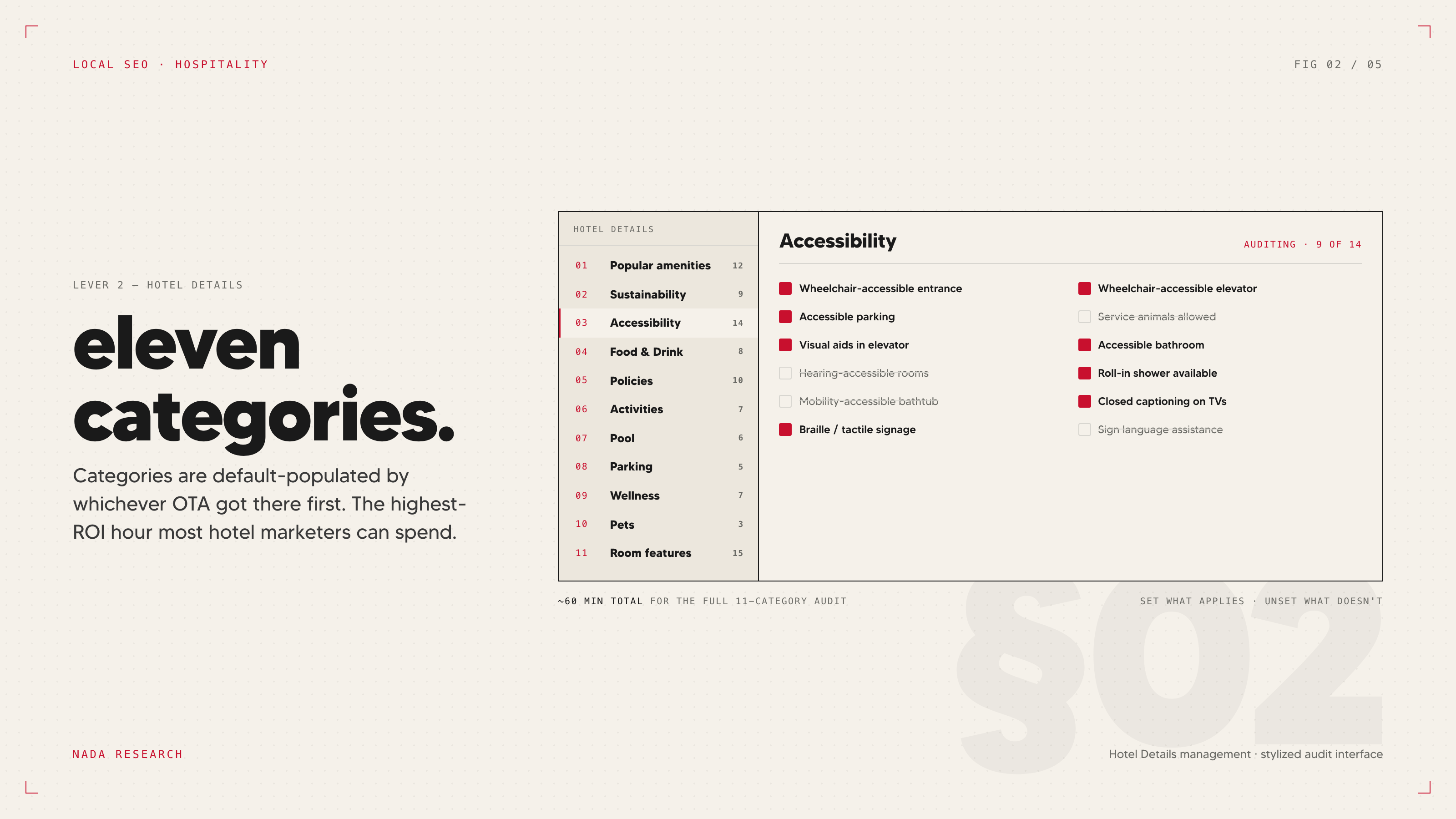
The audit is roughly 90 minutes for a 100-room property. Open the Hotel Details management screen. Walk through every category: Popular amenities. Sustainability. Accessibility. Food & Drink. Policies. Activities. Pool. Parking. Wellness. Pets. Room features. Set every attribute that applies. Unset every attribute that doesn't. The categories that produce the most query lift are usually accessibility (high-intent searches with low competition), sustainability (an increasingly common filter), and pet-friendly status (a binary filter that knocks you out of an entire query class if it's wrong). For European properties, EV charging is rapidly becoming a high-intent attribute.
The reason this audit is the highest-ROI 90 minutes most hotel marketers can spend is that almost nobody does it, and the field has near-perfect signal-to-noise ratio. You set an attribute, it determines your eligibility for amenity-modified queries, and it also feeds into the Compare Prices block and other knowledge-panel surfaces. There is no algorithmic ambiguity here.
Lever 3 — More Hours: the #5 ranking factor almost nobody sets correctly for hotels
More Hours lets you set independent schedules for the restaurant, bar, spa, pool, and front desk — not just the hotel as a whole. Open-at-time-of-search is the 5th most influential local ranking factor per Whitespark, and most hotels leave it on the table by setting the hotel as "Open 24 Hours" and stopping. The tactical move is to populate sub-entity hours for every revenue surface that has its own schedule.
The Whitespark 2026 survey identifies open-at-time-of-search as the 5th most influential ranking factor — more influential than the number of categories, the volume of native Google reviews with text, or the placement of your map pin. Sterling Sky's earlier testing on this finding holds up: rankings begin to degrade in the final hour a business is open each day, and listings that show as closed lose visibility immediately.
For hotels, this is non-obvious. The reflexive answer is to set hours as "Open 24 Hours" because reception is always staffed, and stop. That's the wrong answer. The hotel's main hours can be 24/7, but Google's More Hours fields exist precisely so that sub-entities — the restaurant, the bar, the pool, the spa, the front desk for check-in — can carry their own schedules. Set them. The restaurant that closes at 10pm wants its own hours so that 9:45pm searches for "hotel restaurant near me" can include it and 10:15pm searches don't. The spa that opens at 9am and closes at 7pm wants its own hours so the wellness-seeker searching at 8pm gets accurate information instead of bouncing.
What you lose by leaving these blank: visibility on every search that's running outside your default 24-hour reception window — which is most leisure searches, in practice, since they happen in the evening. The ranking factor Whitespark calls "Open at time of search" is doing real work, and on a hotel, "open" is multi-dimensional.
Lever 4 — Reviews, narrowly
Reviews account for roughly 16–20% of local pack ranking weight, and the three axes that move are volume, recency, and response rate — not review text. Asking guests to mention specific keywords has been controlled-tested and shown no effect. The tactical move is steady velocity, an 80%+ response rate inside 48 hours, and ignoring the highlights badges (you can't edit them).
This post is not about reputation strategy or OTA review management. It's about reviews as a ranking input, which is a narrower question with a clearer answer.
Review signals account for roughly 16–20% of local pack ranking weight per the Whitespark 2026 survey, up from 16% in 2023. The three axes that move are volume, recency, and response rate. Review text — the keywords inside the review body — is where the consensus splits. Whitespark's survey rates keywords-in-reviews as the 9th most influential factor based on practitioner opinion. Sterling Sky's controlled 2024 testing found no effect. The methodologically stronger finding is no effect, but the testing was on a Christmas tree farm and the result may not generalize cleanly to a more competitive multi-keyword vertical like hotels. The safe operating recommendation: ask for reviews systematically, respond to all of them, but don't prompt guests to include specific amenity keywords.
The volume benchmark for hotels is higher than for other verticals. Hotels average ~309 Google reviews across the industry; top-3 ranked local properties average 200+ reviews. A boutique with forty reviews is not closing the gap on volume alone, and chasing volume artificially is how hotels end up flagged for review-gating violations (more on that in the debunks). What works is steady velocity — roughly one new review per week is associated with about 25% higher local search rankings versus inconsistent velocity, per SQ Magazine's 2025 data, with the caveat that the number is contested but consistent across multiple studies — and a high response rate. Eighty percent or more of reviews receiving a response correlates with measurable ranking lift.
One more thing about reviews that catches hoteliers off guard: highlights. The badges that show up on your GBP — "Great service," "Spacious rooms," "Quiet" — are generated from review text and guest travel-type selections. You cannot edit them. There's no admin panel for highlights and no support ticket that will get them changed. They are an output of your review corpus, not an input you control. Stop looking for the edit button.
Lever 5 — Photos
Photos don't move rankings on their own, but OTA photo duplication actively weakens your profile. If your GBP hero is the same image Booking.com is showing, Google's image-matching suppresses individual photo performance and the listing reads as undifferentiated. The tactical move is regular property-shot uploads across the categories Google surfaces (exterior, lobby, room, dining, amenity, neighborhood) — and recognizing that the blue dot on the map is not a photo problem, it's covered in full in Google free booking links.
OTA photo duplication is the issue most independents miss. If your GBP photos are the same images Booking.com and Expedia are showing, you're weakening your profile in two ways: the listing reads as undifferentiated, and Google's image-matching is showing the same hero on three surfaces, which suppresses individual photo performance. Upload property-shot, non-OTA-duplicated images on a regular cadence. The categories Google surfaces — exterior, lobby, room, dining, amenity (pool, spa, fitness), neighborhood — should each be populated with current photography.
The blue dot on your map pin, by the way, is not a photo problem. That's a connectivity-partner and rate-feed problem, covered in the dedicated post on distribution. Photos help the listing convert when traffic arrives. They don't fix distribution gaps.
The ten things you've been told to do that don't work
The differentiation in this section is that the recommendations have been tested, and named sources have published the results. This is not opinion. It's testing. Where it's contested, we'll flag it. Where it isn't, we'll be direct.
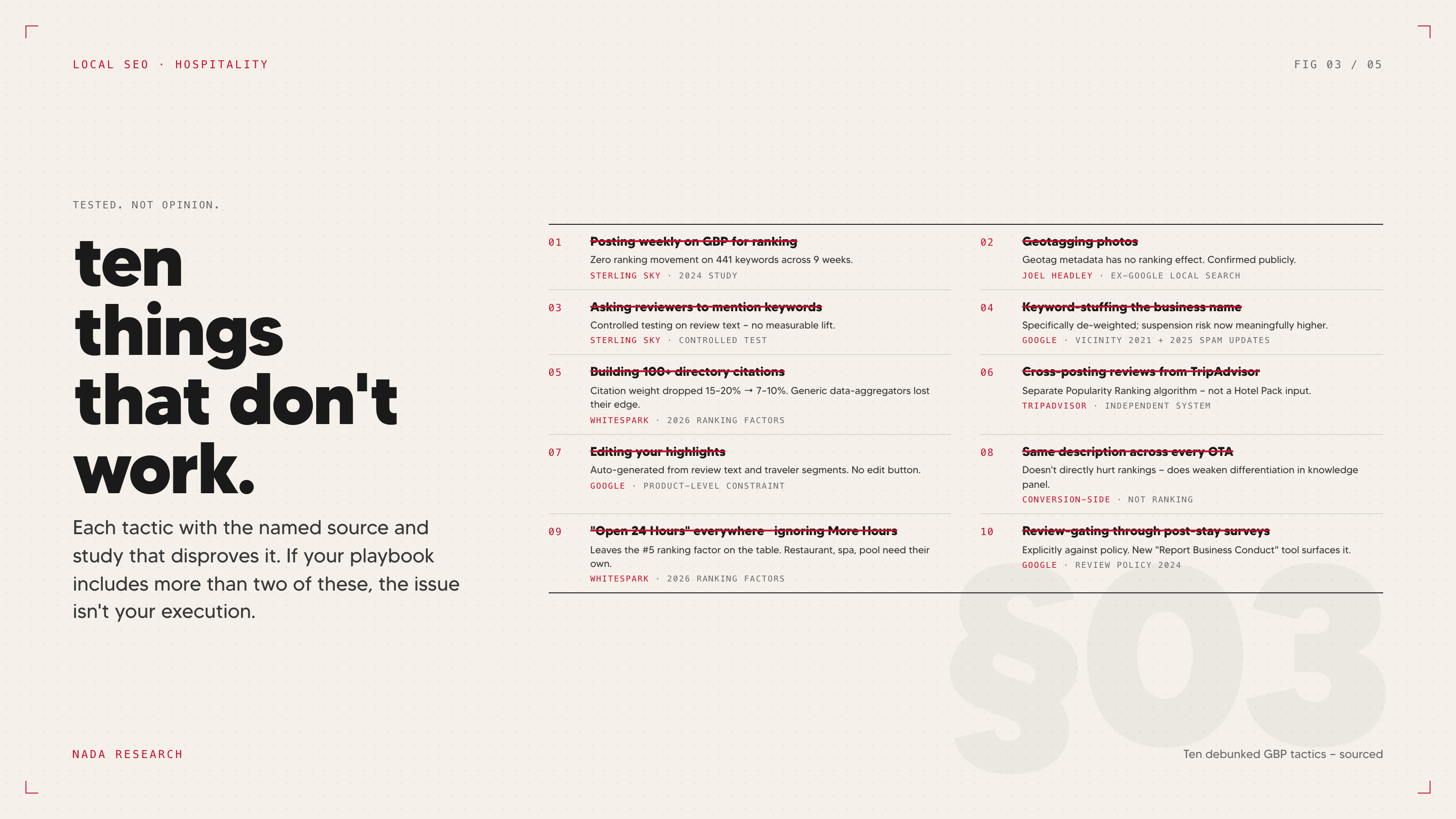
1. Posting weekly on GBP for ranking effect. Sterling Sky's 9-week study tracking 441 keywords found zero ranking movement from Google Business Profile posts. Posts can help with engagement and CTR on the listing surface itself. They do not move pack position. Caveat: hotels' Posts feature was restricted until 2021 and the test wasn't hotel-specific, which leaves a small open question for the vertical (Sterling Sky's Joy Hawkins has been clear that the burden of proof now sits with anyone claiming an effect). Stop building content calendars for ranking. Build them for engagement if you want.
2. Geotagging photos. Sterling Sky's testing and Joel Headley — formerly of Google's local search team — have both publicly confirmed that geotag metadata in photos has no effect on rankings. The myth has staying power because it's plausible-sounding. It's also wrong.
3. Asking reviewers to mention specific keywords. Sterling Sky's controlled testing on review text found no measurable ranking effect. Practitioner opinion in the Whitespark survey disagrees, but the testing is the stronger evidence. Don't include "please mention our rooftop pool!" in your post-stay email.
4. Keyword-stuffing your business name. Google's 2021 Vicinity update specifically de-weighted this, and the 2025 spam updates have made the suspension risk meaningfully higher. Hotels with legal names that legitimately include descriptive terms ("The [Neighborhood] Inn") still benefit. Hotels appending "— Best Boutique Hotel in Downtown" will get caught.
5. Building 100+ directory citations. Citation weight has dropped from roughly 15–20% historically to 7–10% in the 2026 ranking-factor surveys. Google's entity resolution has improved and minor formatting differences ("Street" vs. "St.") no longer matter for established businesses. The exception, which we'll cover in a moment, is unstructured editorial citations — those have gotten more important. Generic data-aggregator submissions have not.
6. Cross-posting reviews from TripAdvisor to drive Google rankings. TripAdvisor runs an entirely separate algorithm (Popularity Ranking) that is not a direct input to the Hotel Pack. Reviews on TripAdvisor help your TripAdvisor visibility. They don't move Google rankings. Manage them on their own merit, not as a Google ranking play.
7. Trying to edit your highlights. Already covered above — they're review-driven outputs. There is no edit button.
8. Pasting the same description across every OTA listing. This doesn't directly hurt rankings, but it weakens differentiation in a knowledge panel where Google is already showing OTA Compare Prices blocks. Distinct descriptions do real work for conversion even when they do nothing for ranking.
9. Setting "Open 24 Hours" across the board and ignoring More Hours. Already covered as Lever 3. Worth flagging again because it's the most common version of "I optimized my GBP" that's actually leaving the #5 ranking factor on the table.
10. Review-gating through post-stay surveys. Routing satisfied guests to Google and unhappy guests to an internal team is explicitly against Google's review policies and triggers review filtering or account-level actions. Google added a "Report Business Conduct" tool in 2024 specifically to surface this practice. The hotel industry's reflex to use post-stay surveys this way crosses the line. Ask every guest, route every response to public platforms.
The shape of this list is roughly the shape of the gap between "what hotel SEO content recommends" and "what controlled testing supports." If the advice you've been operating on includes more than two items from this list, the issue isn't your execution. The issue is the playbook.
The 30-day operating sequence
A four-step sequence, in case the reader wants the operating list:
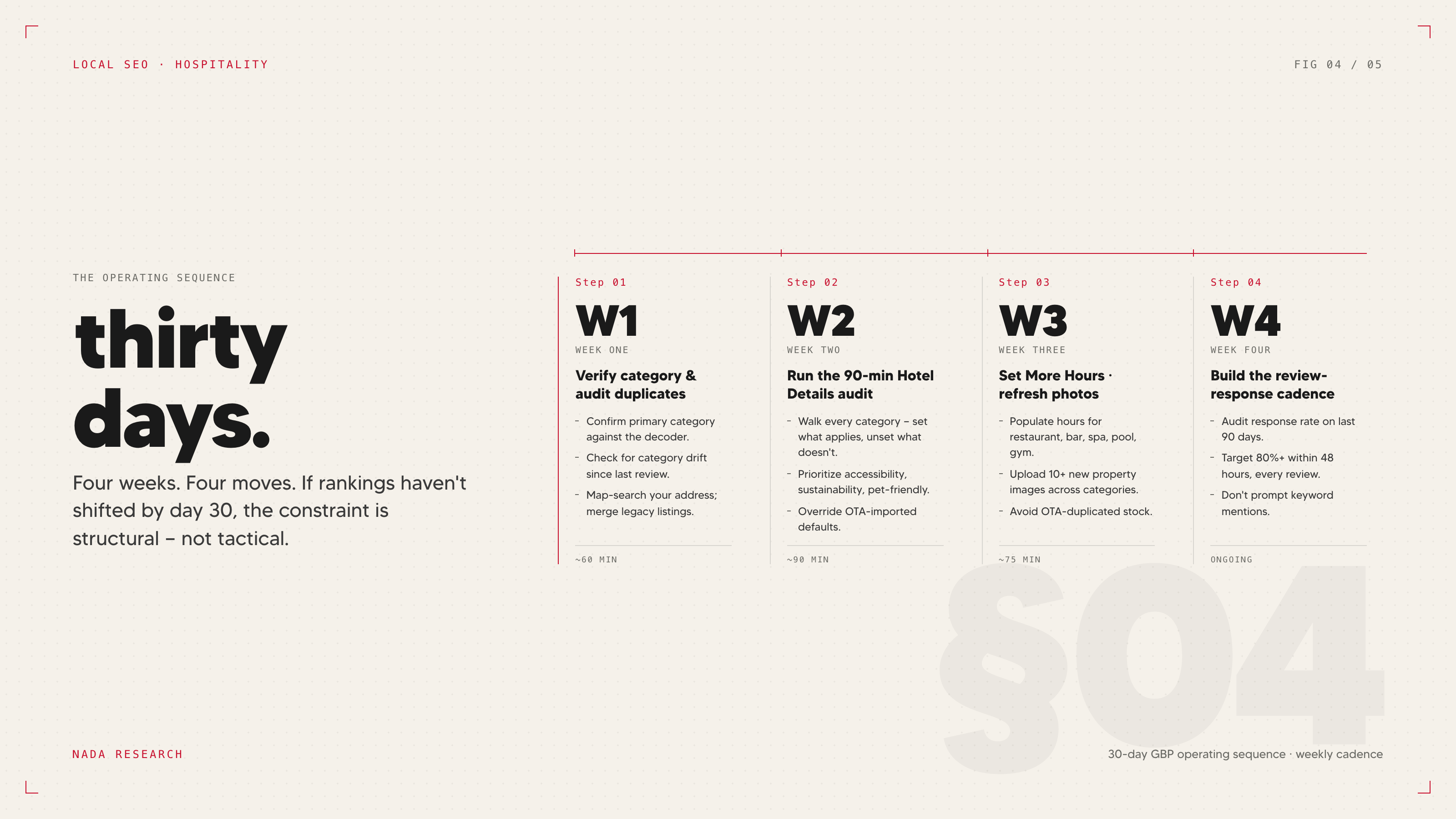
Step 1 (Week 1): Verify primary category and audit for duplicate listings. Open your GBP and confirm the primary category against the decoder in §2. Check for category drift since your last review — Google can change it based on shifting signals without notifying you. Then search Google Maps for your property's street address and audit for duplicate listings. Legacy profiles from previous owners or franchise affiliations are the #1 cause of hotel GBP issues, and they're usually easy to find and easy to merge or report through the GBP backend.
Step 2 (Week 2): Run the 90-minute Hotel Details audit. Open the Hotel Details management screen and walk through every category: Popular amenities, Sustainability, Accessibility, Food & Drink, Policies, Activities, Pool, Parking, Wellness, Pets, Room features. Set every attribute that applies. Unset every one that doesn't. Pay particular attention to accessibility, sustainability, and pet-friendly fields — these are the highest-leverage attribute classes for query eligibility.
Step 3 (Week 3): Set More Hours and refresh photos. Populate More Hours for every sub-entity that has its own schedule — restaurant, bar, spa, pool, fitness center. Then upload at least ten new property-shot images, distributed across the categories Google surfaces (exterior, lobby, room, dining, amenity, neighborhood). Avoid OTA-duplicated images.
Step 4 (Week 4): Build the review response cadence. Review the response rate on the last 90 days of reviews. Build the cadence — every review responded to within 48 hours, target 80%+ response rate going forward. Do not prompt guests to mention specific amenities in their review text.
If you've done this thirty days in and the rankings haven't moved, the constraint isn't tactical. It's structural. Either you're competing for queries the geometry of your market won't let you win — see the pillar post on proximity and the market-type split — or your rates aren't in Google's connectivity feed, which is a different problem with its own Google free booking links audit and a different fix.
Terms used in this post
- Google Business Profile (GBP)
- The free Google product hoteliers use to manage their presence in Google Search and Maps. Formerly called Google My Business.
- Hotel Pack
- The three-result lodging module Google surfaces for hotel queries — three properties with map, ratings, and price pins. Powered by Google Travel, not Google Maps; replaced the Local Pack for lodging in 2018.
- Primary category
- The single most influential relevance signal on a Google Business Profile. For lodging, Google offers at least 12 distinct lodging categories (Hotel, Boutique Hotel, Resort Hotel, Inn, Bed & Breakfast, and others), and the choice filters a property in or out of category-modified searches.
- Hotel Details attributes
- The 90+ structured amenity, accessibility, sustainability, food-and-drink, policy, and room-feature fields inside a hotel GBP. Populated by OTAs by default and frequently outdated until manually overridden.
- More Hours
- A GBP feature that lets a hotel set independent open-hours schedules for sub-entities like the restaurant, bar, spa, pool, and front desk — separate from the hotel's main hours.
- Vicinity update
- Google's late-2021 local algorithm rebalancing that increased the weight of physical proximity and de-weighted keyword-stuffed business names. Named by Joy Hawkins of Sterling Sky and later confirmed by Google.
- Connectivity partner
- A certified third-party platform (Cloudbeds, Mews, SiteMinder, WebRezPro, Hotelogix) that pushes a hotel's rates and availability to Google in real time, enabling price pins on Maps and free booking links in the knowledge panel.
- Hotel Ads
- Google's paid metasearch product for hotel rates. The economic engine of Google's hotel surfaces and the reason most "free" GBP features for hotels are restricted relative to other verticals.
- Online travel agency (OTA)
- Third-party booking sites — Booking.com, Expedia, Hotels.com — that resell hotel inventory and dominate Google's hotel SERP and the default Hotel Details attribute set.
- Ranking factor
- A signal Google uses to determine local pack and Hotel Pack ordering. The Whitespark 2026 Local Search Ranking Factors survey is the canonical practitioner source on relative weights.
- Review-gating
- The practice of routing satisfied guests to public review platforms while diverting unhappy guests to internal feedback channels. Explicitly against Google's review policies and a trigger for review filtering or account-level penalties.
- Highlights
- The badges that appear on a GBP ("Great service," "Spacious rooms," "Quiet"), generated automatically from review text and traveler-segmentation data. Hoteliers cannot edit them directly. ---
Frequently asked questions
-
What's the most important field on a hotel Google Business Profile?
Primary category, by a wide margin. The Whitespark 2026 Local Search Ranking Factors survey ranks it as the #1 relevance signal for local pack and Hotel Pack visibility, and category changes can move rankings within days. Google offers at least 12 distinct lodging categories and most independents have it set wrong — typically defaulting to "Hotel" when "Boutique Hotel," "Inn," or "Bed & Breakfast" would be the accurate match.
-
Do GBP posts move hotel rankings?
No. Sterling Sky's nine-week study tracking 441 keywords found zero ranking movement from Google Business Profile posts. Posts can help with engagement and click-through on the listing surface, but they do not move pack position. The hotel-specific caveat is that Posts were restricted for lodging until 2021, but the burden of proof now sits with anyone claiming a ranking effect.
-
How long should a Hotel Details attribute audit take, and what's the payoff?
Roughly 90 minutes for a 100-room property. The payoff is eligibility for amenity-modified queries — pet-friendly, accessibility, EV charging, sustainability, rooftop pool — which post-Vicinity is where independents actually compete. Attributes are populated by whichever OTA reached Google first, so the default state is often outdated or wrong, and the field has near-perfect signal-to-noise ratio: set the attribute, become eligible for the query.
-
Should hotels ask guests to mention specific amenities in their reviews?
No. Sterling Sky's controlled testing on review text found no measurable ranking effect from keyword-stuffed reviews. Practitioner opinion in the Whitespark survey disagrees, but the controlled testing is the stronger evidence. Ask for reviews systematically and respond to all of them — but don't prompt guests to include specific amenity keywords in the body.
-
Why does More Hours matter so much for hotels specifically?
Open-at-time-of-search is the 5th most influential local ranking factor per the Whitespark 2026 survey, and for hotels it's multi-dimensional. Reception is 24/7, but the restaurant closes at 10pm, the spa at 7pm, the bar at midnight. Each sub-entity wants its own More Hours entry so that searches running outside default reception hours — which is most leisure searches, in practice — can still surface the property accurately.
-
Are directory citations still worth building for a hotel?
Mostly no. Citation weight has dropped from roughly 15–20% historically to 7–10% in the 2026 ranking-factor surveys, and Google's entity resolution now handles minor formatting differences automatically. The exception is unstructured editorial citations — travel-publication mentions, "best of" lists, regional press — which have grown more important, particularly for AI Overview and AI Mode visibility. Generic data-aggregator submissions have not.