Hotel SEO
Stop Trying to Rank for 'Hotels in [City]': The Hotel Keyword Map That Actually Converts
Abstract
Independent hotels should stop targeting head terms like "hotels in [city]" and route content investment into five specific query patterns the OTAs and AI Overviews haven't taken away yet. Two numbers make the case. "Hotels in Austin" generates roughly 33,000 monthly US searches (Ahrefs, late 2025), and the click-through to an individual hotel website on that SERP — once the Hotel Pack, OTA stack, and AI Overview take their share — sits in the low single digits. "South Congress boutique hotel Austin" gets perhaps 200–400 monthly searches, but the click-through to a hotel website is roughly 8–12 times higher per impression. The long-tail query is worth more booked revenue per thousand impressions than the head term.
![Five hotel keyword query patterns — neighborhood, landmark, amenity, purpose, and travel-party — replacing the crossed-out generic 'hotels in [city]' head term.](/_image?href=https%3A%2F%2Fsatchel.studio%2Fapi%2Fmedia%2Ffile%2Fpost-6-fig-0-hero.png&w=3200&h=1800&f=webp)
The math on the head term is worse than it looks. Even if you "won" it, you'd be one of three properties Google picks for the Hotel Pack on proximity grounds, and probably not the one closest to where the searcher is standing. Below the pack, the organic results are OTAs and an AI Overview summary. Individual hotel websites haven't been a regular feature of those organic results since 2018. The keyword every hotel marketer has been told to chase is, structurally, a rounding error in the booking funnel even if you win it. If the question is how to beat the OTAs on Google, the answer isn't outranking them here. It's the free booking link that puts your direct rate beside theirs in the knowledge panel, which is a rate-feed toggle, not a ranking.
This is not a "long-tail keywords matter" post. That advice has been in circulation for a decade and is too vague to act on. The strategy that works for hotels is more specific — five winnable query patterns, with priority depending on whether you're in a dense urban market or a thin one. The rest of this post is the map.
Why "hotels in [city]" was taken away from you
In 2018, Google removed localization from organic search results for "hotel + location" queries — individual hotel websites stopped appearing, and the Hotel Pack became the only direct surface above the OTA stack. The 2021 Vicinity update tightened that further, de-weighting keyword-stuffed names and shrinking the ranking radius. The full mechanic — why hotels were structurally separated from the Local Pack and what's left to win — is in the Hotel Pack vs. Local Pack pillar.
The five winnable query patterns
What's left is more interesting than the head term ever was. Five patterns, each tied to a specific traveler intent, each mapping to a specific kind of site page, each with a specific GBP attribute or category that determines whether you're eligible to appear. This is the core of any working boutique hotel SEO strategy — a real map, not a generalized appeal to "long-tail."Neighborhood + hotel. Neighborhood queries pair a specific district or sub-area with a hotel modifier — "Soho boutique hotel," "South Congress hotel Austin," "Marais hotel Paris." They come from travelers who have already decided where to stay and are now comparing properties within a chosen area. The site asset is a neighborhood landing page that's genuinely about the neighborhood: what it's like to stay there, what's nearby, who the area suits. Not a thin "things to do in Soho" template repurposed. The GBP requirement is that your address actually places you in the neighborhood and your category is correctly set — boutique searchers filter for Boutique Hotel; if you're set as Hotel, you're eliminated from the query class (see the GBP levers post for the category decoder). Winnable for: dense urban properties, especially boutique. Not winnable for: properties on the wrong side of a neighborhood boundary, properties miscategorized.
Landmark + hotel. Landmark queries — the core of hotel landmark SEO — pair a named place (a venue, transit hub, cultural site, stadium) with a hotel modifier, like "hotel near Times Square" or "hotel near Boston Common." The traveler is planning around a specific reason to be there. The site asset is a landmark-specific page: walking distance, transit, what staying near this landmark feels like. The GBP requirement is your physical proximity (which is fixed) plus accurate Hotel Details on the amenities travelers near that landmark care about — business travelers near a convention center care about workspace and Wi-Fi; cultural-travel guests near a museum care about quiet, walkability, breakfast. Winnable for: properties within a quarter-mile or so of meaningful landmarks. Not winnable for: properties two miles away trying to compete with properties one block from it.
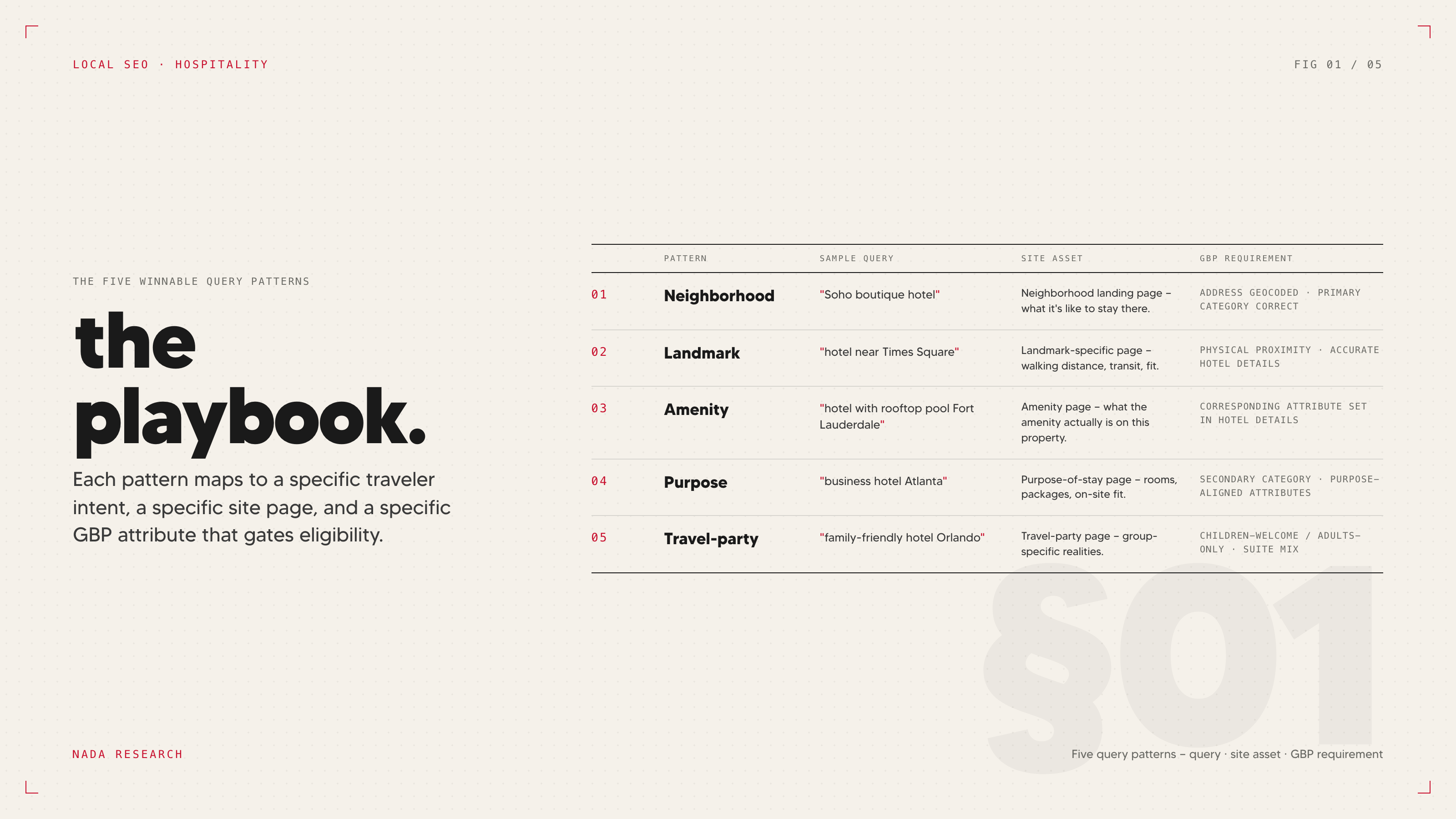
Amenity + hotel. Amenity queries are filter-driven searches pairing a feature — pool, EV charging, pet policy, accessibility — with a hotel modifier: "hotel with rooftop pool Chicago," "wheelchair-accessible hotel Seattle." These are often the highest-intent of the five patterns, and they map directly to the Hotel Details attributes inside the GBP. The site asset is an amenity page that walks the traveler through what the amenity actually is on this property — not a checklist. The GBP requirement is that the corresponding attribute is set in Hotel Details. This is where the 90-minute attribute audit in the GBP post pays for itself. If the attribute isn't set, you're not eligible for the query, regardless of how good your site page is. Winnable for: any property with an honest amenity advantage that's properly attributed. The most underused class of queries in hotel SEO.
Purpose + hotel. Purpose queries layer trip-context onto destination — "business hotel Atlanta," "wedding hotel Napa," "anniversary hotel Charleston," "hotel for a remote work week Lisbon." The traveler is asking which property fits the use case. The site asset is a purpose-of-stay page that's specific about the property's fit: which rooms, which packages, which on-site features support it. The GBP requirement is sometimes a secondary category (Wedding Venue, Conference Center) and sometimes specific Hotel Details attributes (workspace in room, fast Wi-Fi). Winnable for: properties with a real, defensible angle on the use case. Not winnable for: any property trying to be all things to all travelers — purpose queries reward specificity.
Travel-party + hotel. Travel-party queries frame the trip around who's coming — "family-friendly hotel Orlando," "couples hotel Tulum," "girls' trip hotel Charleston," "solo travel hotel Lisbon." These travelers are planning around the practical realities of the group. The site asset is a travel-party page that addresses those realities: connecting rooms, kid policies, romantic features, group packages. The GBP requirement is a mix of attributes (children welcome, adults-only, suite availability) and the right category. Winnable for: properties with a clear positioning. Not winnable for: properties whose real positioning is "for everyone," which is, in keyword terms, for nobody.
A decoder is useful here. Dense-urban boutiques rely on neighborhood and landmark queries, with amenity queries filling the gaps. Urban full-service hotels lean on landmark and purpose (especially business and wedding). Thin-market and resort properties weight toward amenity, purpose, and travel-party; neighborhood matters less when geography isn't tightly segmented. Pick two or three patterns that fit your property and concentrate investment there.
"Near me" is a distraction for most hotels
There's a sixth query pattern that gets bundled with the five above in most hotel SEO writing, and it shouldn't be: "near me." "Hotel near me," "boutique hotel near me," "pet-friendly hotel near me." These look like the queries above but they're behaviorally different.
Google interprets "near me" geographically — based on where the searcher is standing, not where they intend to travel. For hotels, this means "near me" searches are largely useful only for walk-up demand: drivers looking for a room now, airport travelers with a cancelled flight, locals booking a staycation. The dominant booking behavior — the one that fills most independent boutiques' rooms — is an origin-city traveler searching "[destination] + hotel" while planning a trip from a different city. They're not "near" anything. They're at home, on a laptop, three weeks from arrival.
The exceptions are airport hotels, hotels next to event venues, and downtown business hotels with consistent walk-up trade. Everyone else is better off building content for planning behavior — destination, neighborhood, landmark, amenity — and letting "near me" optimization fall out as a side effect of well-set GBP fundamentals.The more honest framing: design your strategy around how your guests are actually searching three weeks before arrival, not how someone might search at 11pm with a dead car battery.
Playbook for dense urban markets
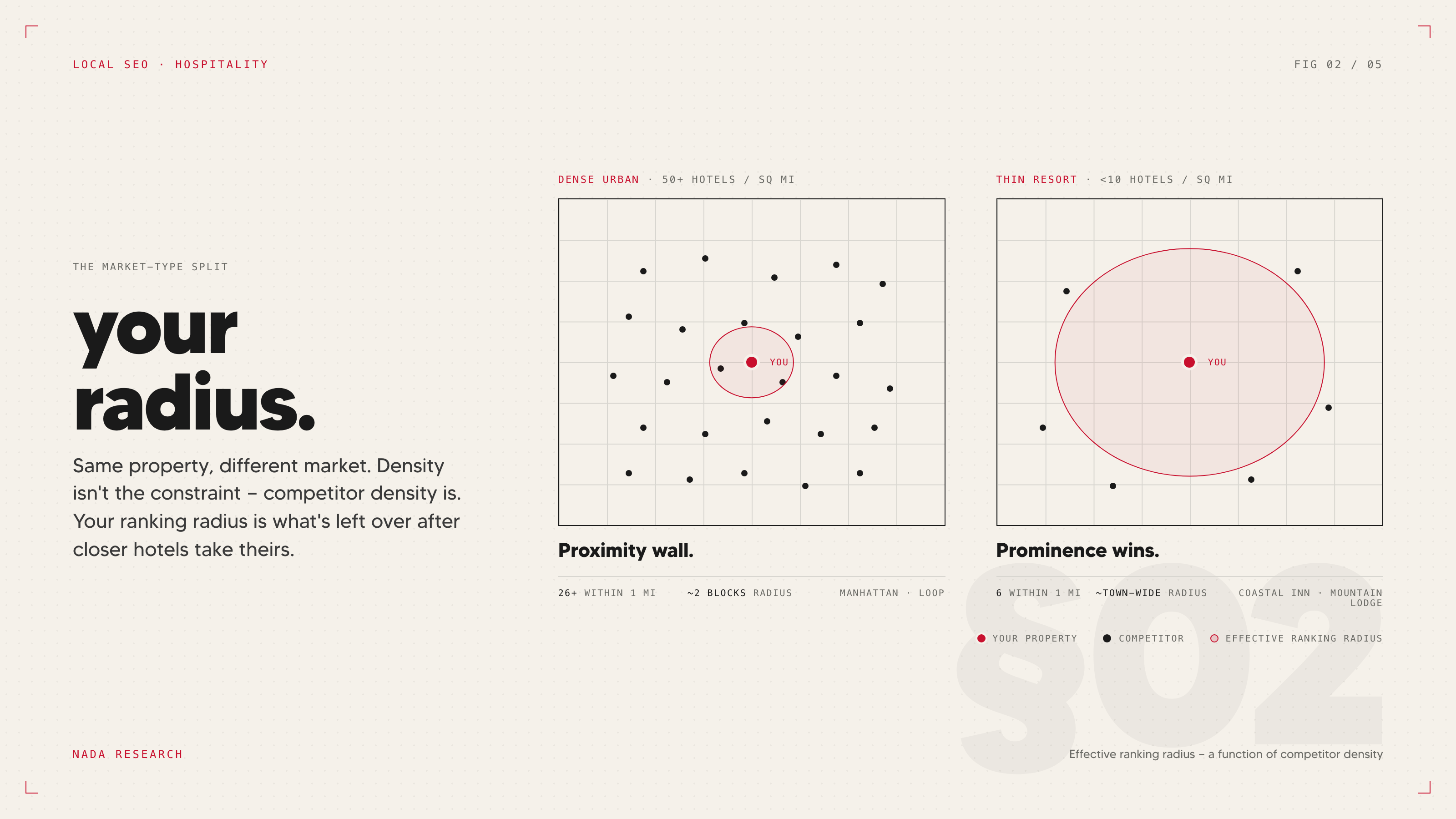
Dense urban — roughly 50 or more hotels within a square mile — means most of Manhattan, central London, the Loop, downtown San Francisco, central Tokyo, central Paris. In these markets, neighborhood hotel keywords are the workhorse of the strategy because proximity is a wall: the Hotel Pack will surface whichever three properties are closest to where the searcher is standing or to the landmark they named. Prominence signals can partially offset proximity, but rarely enough to leap past ten or fifteen closer competitors.
The content strategy that works here is hyperlocal, modifier-driven, and structurally tied to the GBP attributes. Build one neighborhood page per neighborhood the property is genuinely part of (usually one or two — don't fake adjacency). Build one landmark page per major landmark within a half-mile to a mile radius — convention centers, transit hubs, cultural institutions, stadiums, retail districts. Each landmark page is its own piece of work: walking distance, nearest transit, what's around. Build amenity pages only for the two or three amenities that are genuinely competitive on the property. A "hotel with rooftop pool" page only makes sense if the rooftop pool is a real feature, not a mention.
Tie each of these pages to the GBP setup. Neighborhood pages need the address geocoded correctly and the primary category right. Landmark pages need accurate Hotel Details attributes. Amenity pages need the corresponding GBP attributes set. The site assets and the GBP work together; either alone underperforms.
Don't bury these pages four clicks deep under "Things to Do" — they should sit one click from the homepage. Skip generic "About the Area" pages; they're commodity content and don't rank for any of the five patterns.
Playbook for thin/resort markets
Thin markets — coastal inns, mountain lodges, secondary cities, small towns — invert the math. There aren't enough competitors for proximity to be decisive. A 60-room property in Asheville isn't fighting fifty other downtown properties for pack visibility; it's fighting six. Prominence signals carry real weight in this environment, and the playbook shifts accordingly.
Editorial citations on travel publications carry meaningful weight here. Whitespark's 2026 analysis identifies unstructured citations — editorial mentions in travel media, "best of" lists, regional press — as one of the strongest emerging signals, particularly for AI Overview and AI Mode visibility, where they're treated as primary inputs. Three of the top five AI Search Visibility factors in the Whitespark survey are citation-related, and unstructured citations on travel publications outperform structured directory citations in this context.
Practically, the content investment for thin-market properties is more about earned editorial than owned content. Pitch travel writers. Get on regional "best of" lists. Build partnerships with local attractions that result in cross-mentions. Sponsor local events that generate press. Tourism board listings matter here in a way they don't in dense urban markets — and the way the property describes itself in those listings should match how it wants to be searched for.
The owned content that works in thin markets is destination content with a clear authorial voice. Generic "things to do in [region]" posts don't rank and don't get cited. "Where to eat in [region]" with named recommendations from someone with credibility, dated, with photographs, with a real perspective — that does. The signal AI Overviews and AI Mode are reaching for is signal that looks like editorial, not signal that looks like SEO content.
A note on AI Overviews
Travel queries saw a 381% increase in AI Overview presence between March 13 and 27, 2025 alone, per BrightEdge data. By early 2026, AI Overviews appeared in roughly a quarter of all US searches. The informational queries that used to send traffic to destination content — "best time to visit Savannah," "things to do in Taos with kids," "best neighborhoods in Lisbon" — are increasingly answered before the user clicks anything. The traffic that used to come from those upper-funnel queries to a hotel's destination blog is, in many cases, gone.
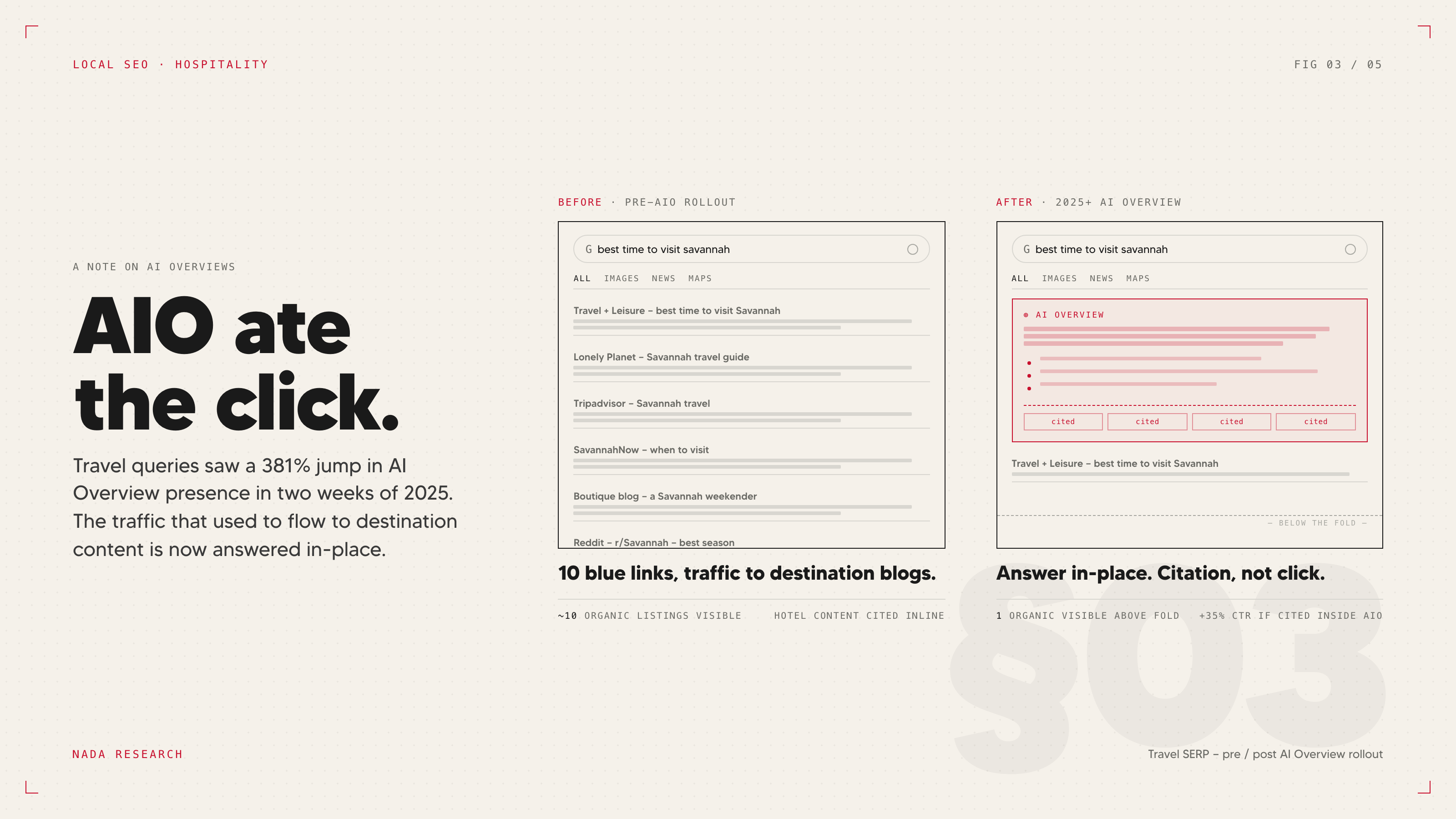
The counter-move is citation, not click. Brands cited inside AI Overviews earn 35% more organic clicks per Seer Interactive's September 2025 data, even as overall CTR declines when AIOs are present. Optimizing for AIO citation differs from optimizing for clicks: structured data, direct-answer content patterns, named author bylines, citable statistics inside the content itself.
A caveat worth being explicit about. There's a widely-cited Feefo figure that roughly 71% of AI-generated hotel recommendations are driven by guest reviews. The methodology behind that number isn't fully disclosed, and it should be treated as directional rather than load-bearing. The honest statement is that reviews appear to be a major input to AI-generated travel recommendations; the precise weight is not settled science. Operate accordingly: keep review velocity and response rate strong, but don't restructure your strategy around a single under-documented stat.
If you have to choose two or three query patterns to carry the next 90 days of content investment, the shape of the decision is roughly this:
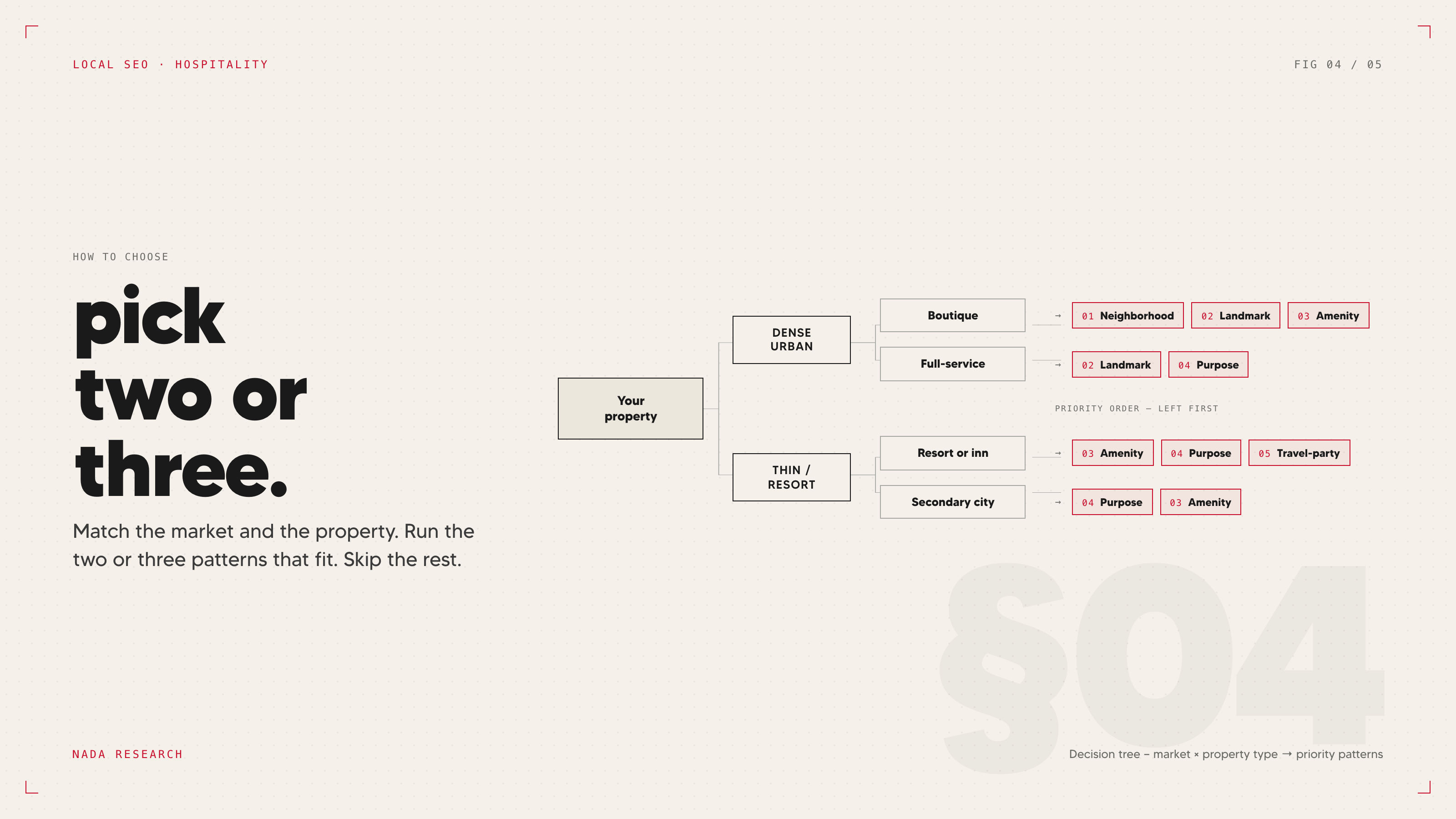
A dense-urban boutique should put 70% of investment into neighborhood and landmark pages, with amenity pages for the two or three amenities that are genuinely competitive on the property.
An urban full-service hotel should weight toward landmark and purpose pages — especially around business travel and weddings if those are real revenue lines.
A thin-market or resort property should weight toward earned editorial citations and toward purpose, amenity, and travel-party content with a real authorial voice.
The GBP attribute settings that make any of this work — particularly the amenity queries — are the connecting piece, and they're covered in detail in the GBP playbook listed in related posts. The distribution piece, which determines whether your direct rate even appears once a guest clicks through, is in the free booking links post.
Terms used in this post
- Head term
- A short, high-volume search query like "hotels in Austin" — broad, generic, and dominated by OTAs, the Hotel Pack, and AI Overviews on the SERP. Structurally a rounding error in an independent hotel's booking funnel even if the property "wins" it.
- Long-tail query
- A more specific, lower-volume search query that tends to convert at a substantially higher rate per impression. For hotels, long-tail queries are the five winnable patterns — neighborhood, landmark, amenity, purpose, and travel-party.
- Neighborhood query
- A search pairing a specific district or sub-area with a hotel modifier ("Soho boutique hotel," "South Congress hotel Austin"). Comes from travelers who have already decided where to stay and are comparing properties within a chosen area.
- Landmark query
- A search pairing a named place (venue, transit hub, cultural site, stadium) with a hotel modifier ("hotel near Times Square"). The traveler is planning around a specific reason to be there.
- Amenity query
- A filter-driven search pairing a feature — pool, EV charging, pet policy, accessibility — with a hotel modifier. Maps directly to the Hotel Details attributes inside a Google Business Profile.
- Hotel Pack
- The three-result lodging module Google surfaces for hotel queries — three properties with map, ratings, and price pins. Powered by Google Travel, not Google Maps; replaced the Local Pack for lodging in 2018.
- Local Pack
- Google's standard three-result local-business module for non-lodging queries — dentists, plumbers, restaurants. Includes phone, website link, directions, and hours, none of which the Hotel Pack shows.
- Vicinity update
- Google's late-2021 local algorithm rebalancing that increased the weight of physical proximity and de-weighted keyword-stuffed business names — shrinking the ranking radius and tightening which queries an independent can realistically win.
- Prominence signals
- Ranking inputs based on a business's perceived importance — review volume, link authority, citation depth, editorial mentions. Distinct from proximity, and especially load-bearing in thin/resort markets where competitive density is low.
- Unstructured citation
- An editorial mention of a property in travel media, a "best of" list, or regional press — distinct from a structured directory citation. Increasingly important for AI Overview and AI Mode visibility.
- AI Overview / AI Mode
- Google's generative-AI search surfaces. AI Overviews summarize answers above traditional results; AI Mode is a fuller conversational interface that increasingly handles upper-funnel travel queries directly.
- Google Business Profile (GBP)
- The free Google product hoteliers use to manage their presence in Google Search and Maps. The category and Hotel Details attribute settings determine eligibility for most of the query patterns above. ---
Frequently asked questions
-
What's the difference between "hotels in [city]" queries and "neighborhood + hotel" queries?
"Hotels in [city]" queries return a SERP dominated by OTAs, the Hotel Pack, and an AI Overview — individual hotel websites haven't reliably appeared there since 2018, so the head term is structurally an OTA market. "Neighborhood + hotel" queries ("Soho boutique hotel," "South Congress hotel Austin") return a more navigable SERP with a tighter Hotel Pack and real opportunity for a property's own neighborhood landing page to rank. The intent is also sharper — the searcher has chosen the area and is comparing properties.
-
How do I know if my hotel is in a dense urban market or a thin market?
The rough threshold is 50 or more hotels within a square mile. If you're in central Manhattan, the Loop, downtown San Francisco, central London, central Paris, or central Tokyo, you're dense urban and proximity is a wall. If you're in Asheville, Telluride, the Outer Banks, a secondary city downtown, or a coastal town, you're thin-market and prominence signals carry more weight. Simple test: open Google Maps, search "hotel" within a one-mile radius, count the pins. Above 50, dense; below 20, thin; in between, mixed.
-
Should I build a separate landing page for each query pattern?
Yes for the patterns that fit your property — but not all five. A dense-urban boutique typically needs one or two neighborhood pages and three to five landmark pages, plus amenity pages for the two or three amenities that are genuinely competitive. An urban full-service hotel weights toward landmark and purpose. A thin-market property weights toward purpose, amenity, and travel-party. The mistake is building thin pages for every pattern; a focused six-to-ten-page set, each substantive, outperforms a sprawling templated twenty-page set.
-
Are "near me" hotel searches worth optimizing for?
For most independents, no. "Near me" is interpreted geographically — based on where the searcher is standing — so it captures walk-up demand: drivers looking for a room now, stranded travelers, locals booking staycations. The dominant booking behavior for independent boutiques is an origin-city traveler planning three weeks out from a different city, who isn't "near" anything. The exceptions are airport hotels, hotels adjacent to event venues, and downtown business hotels with consistent walk-up trade. Everyone else gets "near me" visibility as a side effect of well-set GBP fundamentals.
-
How does Google's Hotel Pack differ from the regular Local Pack?
Different SERP feature, different infrastructure: the Local Pack runs on Google Maps, the Hotel Pack on Google Travel, and hotels appear in the second one rather than the first. The full mechanics are in the Hotel Pack vs. Local Pack pillar.
-
Which of the five query patterns should a boutique hotel prioritize first?
For a dense-urban boutique, neighborhood and landmark queries first, in that order — they map closest to how boutique guests actually search and they reward the kind of editorial, place-specific content boutiques can produce honestly. Amenity pages come next, but only for the two or three amenities that are genuinely competitive. Purpose and travel-party come fourth and fifth and only if the property has a real angle. For a thin-market boutique, invert: lead with purpose and travel-party, then amenity, with neighborhood and landmark as secondary work.