Hotel SEO
The Hotel Pack Isn't the Local Pack — And Why Every Hotel SEO Guide You've Read Got It Wrong
Abstract
That middle module is not the Local Pack. It hasn't been since 2018, and it runs on different rules. The "claim your Google Business Profile and complete every field" advice that fills the top of search results was written for dentists, plumbers, and law firms — not for hotels, which haven't competed in that pack for nearly eight years.
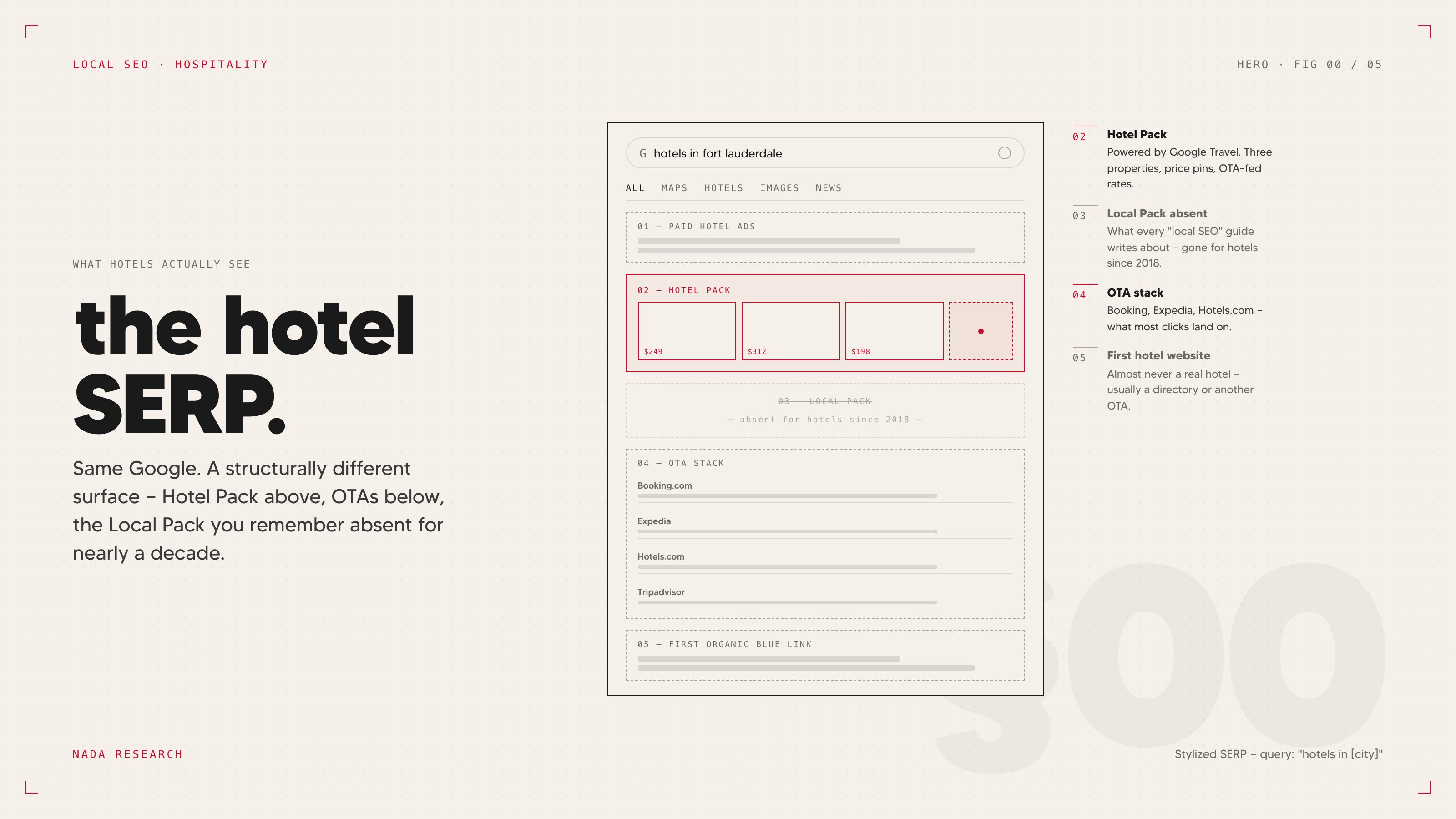
Open a clean browser tab, log out of Google, and search for hotels in any major US city. You'll see the same sequence every time: a row of paid hotel ads, then a module that looks like the local pack you remember from five years ago — three properties, a map, star ratings, a price next to each — then a stack of OTA results from Booking.com, Expedia, and Hotels.com, and finally, somewhere down the page, the first organic blue link, which is almost never an actual hotel website.
This is the single most consequential fact in hotel SEO, and almost every guide written for hoteliers ignores it. Most of what you've been told to optimize is either irrelevant or locked behind features Google has deliberately walled off for lodging. The reason your Google Business Profile (GBP) work feels thinner than the effort you're putting in is that the playbook was written for the wrong SERP feature.
What the Hotel Pack actually is
The Hotel Pack is the three-result lodging module that Google surfaces for hotel queries — three properties with a map, star ratings, and price pins, powered by Google Travel rather than Google Maps. It replaced the standard Local Pack for lodging in 2018, hides the website link and phone number that local-pack listings show, and routes users into a "Compare Prices" panel that surfaces online travel agency (OTA) rates before the hotel's own. It is, structurally, a different product from the Local Pack — and most GBP optimization advice doesn't apply to it.
In 2018, Google made a quiet change to its local algorithm: for queries that combined "hotel" with a location ("hotels in Chicago," "boutique hotel Austin," "Soho hotel"), it stopped surfacing localized organic results that included individual hotel websites. The Hotel Pack — powered by Google Travel, not Google Maps — became the only direct surface where individual hotels could appear above the OTA stack. Tim Capper's BrightLocal guide is one of the few pieces of public SEO writing that names this clearly. The rest of the industry has been operating as if hotels still play in the same pack as everyone else.
Look at the two side by side and the design difference is not subtle.
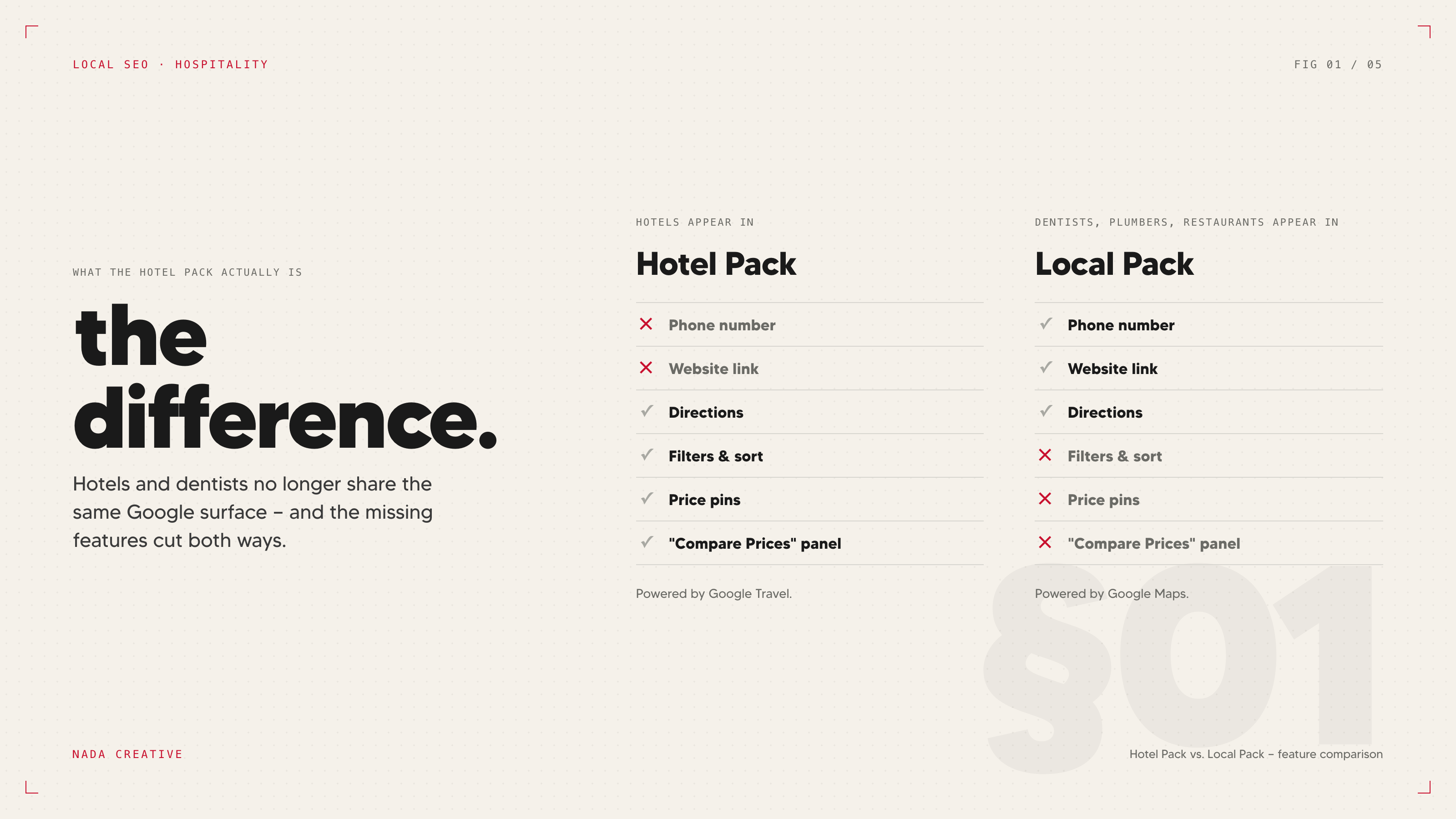
The Local Pack — the one a dentist or a CPA shows up in — gives every business a phone number, a click-through to the website, a directions button, hours, and on mobile, a "call" CTA that occupies more screen real estate than the listing's name. The user can act on the result without leaving the SERP.
The Hotel Pack does almost none of that. There's no phone number on the listing. There's no direct website click in the profile header. There's no booking button unless the property is integrated with Google's Hotel Ads program through a connectivity partner. What there is, baked into the module: a filter UI for price range, star rating, guest rating, amenities, and neighborhood; price pins drawn from OTA rate feeds; and a "Compare Prices" block in the knowledge panel that surfaces Booking.com, Expedia, and Hotels.com before it surfaces the hotel's own rate. The user is being routed to OTAs by design, and the hotel's GBP is doing about a third of the work a dentist's GBP does on its own behalf.
This is not a UX accident. It's an ad-revenue architecture. Google's hotel business runs on Hotel Ads — the paid metasearch product — and the free surfaces around it are calibrated to keep the OTAs visible enough that they keep bidding. Tim Capper makes this point in plain terms in his BrightLocal piece, and it's worth saying out loud: the architecture suggests these restrictions are calibrated around ad-revenue economics — Google's hotel business runs on Hotel Ads, and the free surfaces are designed to keep OTAs visible enough to keep bidding.
The downstream consequence for a marketing director is that the standard checklist of GBP optimizations — set up Offers, post weekly Updates, add Products, enable messaging — is mostly inapplicable. Hotels can't run Offers. Can't add Products. Posts are restricted to informational content (renovations, events) with no promotional language. The "highlights" that show up on the profile are generated from review text and traveler segmentation; the hotelier can't edit them. Attributes are populated by whichever OTA got there first, and they're frequently wrong, until someone manually overrides them. Eight of the top ten Local Pack ranking factors come from the Google Business Profile itself in the Whitespark 2026 Local Search Ranking Factors survey — but for hotels, half the surface that ranking advice points to is locked.
What's left is a smaller set of levers, used correctly. We'll get to those. First, the proximity problem, because it explains why even the levers that do work behave differently than they did three years ago.
The proximity wall and why Vicinity 2021 was the most important hotel SEO event in five years
Google's November–December 2021 "Vicinity update" was the largest change to the local algorithm since Possum in 2016, and it tightened the proximity radius enough that hotels which had been ranking city-wide from a single location lost that visibility overnight. The update primarily rebalanced proximity as a ranking factor and de-weighted keyword-stuffed business names. Joy Hawkins and Sterling Sky named the update; Google later confirmed it as a "rebalancing of factors." The map pack zoomed in. Names stuffed with keywords ("Best Hotel in Chicago — Downtown Luxury Inn") stopped getting the lift they once did.
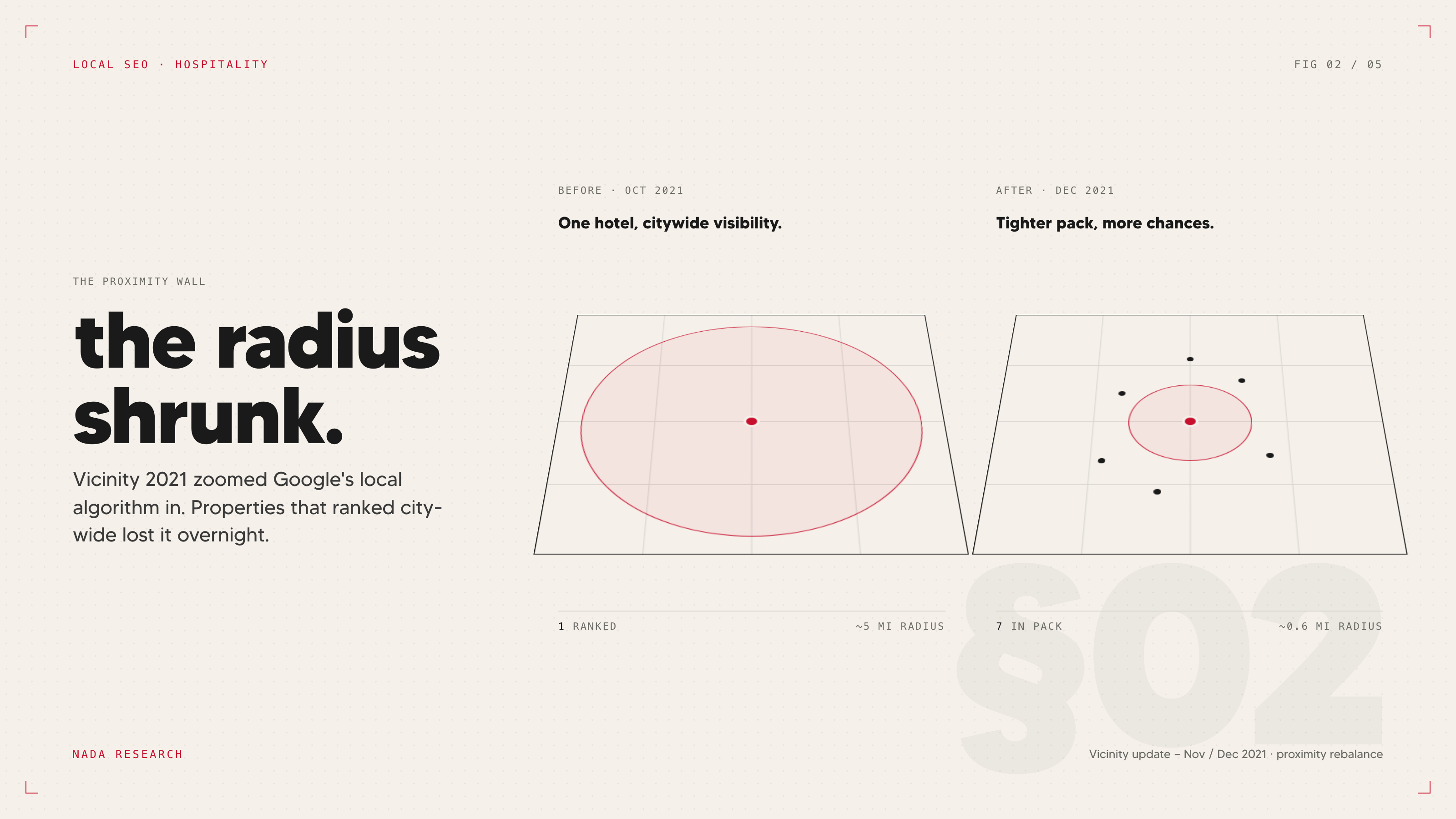
For chain hotels with brand authority and large review counts, Vicinity was a setback. They'd been pulling in city-wide visibility on prominence signals; that visibility shrunk to the actual neighborhood. For independents, the read is more interesting. Vicinity didn't only cut both ways — it cut more against incumbents. A 280-room Hilton that had been ranking for "hotels in [city]" five miles from downtown lost that ranking. So did the over-optimized independent that had shoehorned its location into its business name. What's left is a tighter, more honest ranking radius, where a 60-room boutique in Soho actually has a chance against a 400-room flag — provided it competes for Soho queries, not Manhattan queries.
The strategic reframing is uncomfortable for anyone who built their content plan around head terms. Proximity now accounts for roughly 55% of local ranking decisions per the Whitespark 2026 survey. You can't move your hotel. The query you should be ranking for is not "hotels in [city]" — that's structurally lost to OTAs in organic and to whichever three properties Google happens to pick on proximity in the Hotel Pack. The query you can win is the one that already names your neighborhood, your nearest landmark, or your specific amenity. We'll come back to keyword strategy in the spoke post on the hotel keyword map.
The market-type split
The next thing every generic hotel SEO post gets wrong is treating "hotels" as a single category for ranking purposes. The mechanics in a dense urban market are not the mechanics in a thin or resort market. The playbooks aren't variations on a theme; they're different jobs.
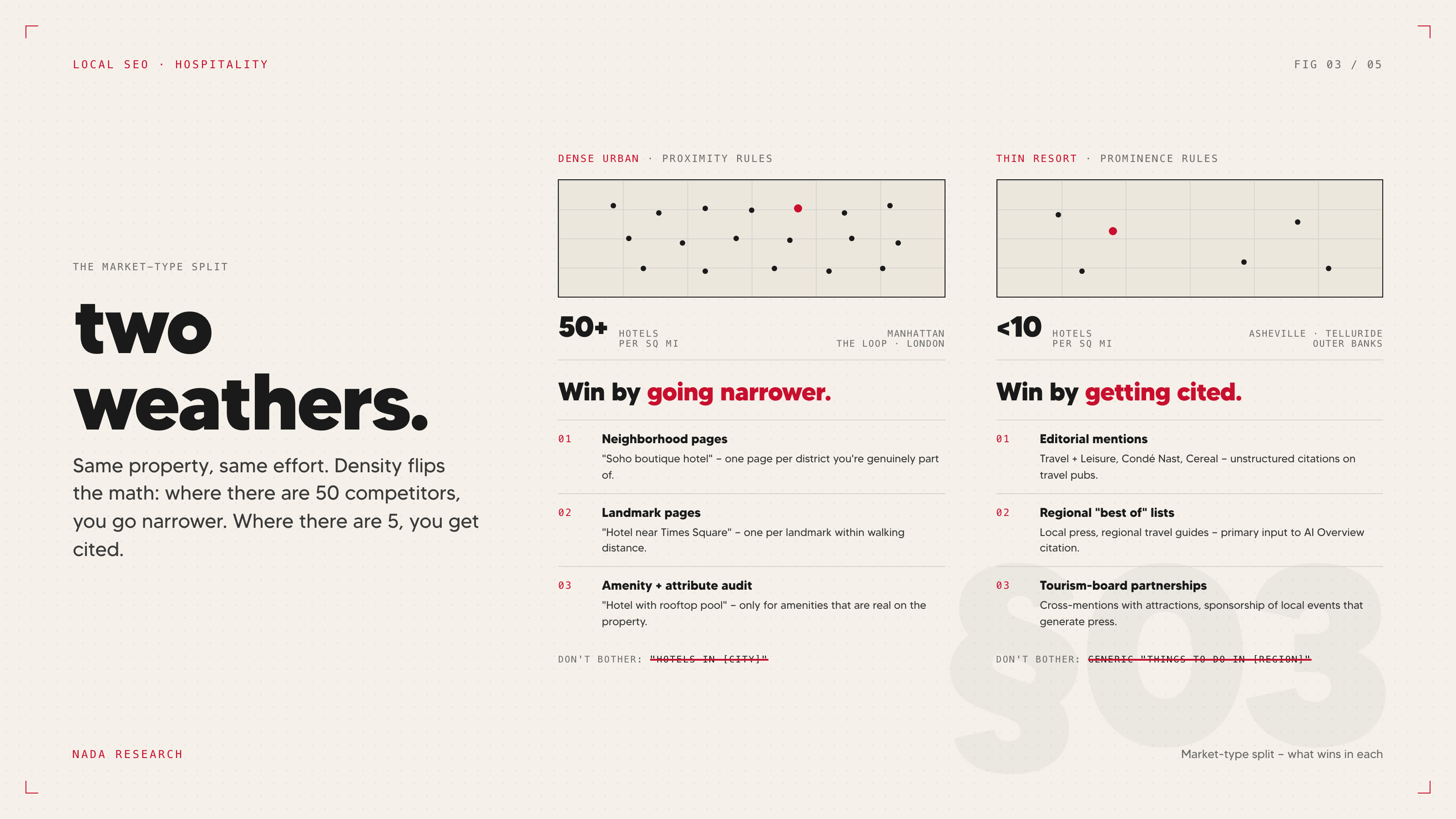
In a dense urban market — call it 50 or more hotels within a mile, which is most of Manhattan, central London, the Loop, downtown San Francisco — proximity is a wall. The Hotel Pack will surface whichever three properties are closest to where the searcher is standing or to the landmark they named. Prominence signals (review count, link authority, citation depth) can partially offset proximity but rarely enough to leap past ten or fifteen closer competitors. Modifier queries are where independents win: "boutique hotel near [specific landmark]," "[neighborhood] hotel with rooftop," "hotel near [subway stop] with parking." That's the entire game.
In a thin or resort market — coastal inns, mountain lodges, secondary cities, small towns — the math inverts. There aren't enough competitors for proximity to be decisive. Prominence signals carry real weight. Reviews, editorial citations on travel publications, "best of" list placements, and partnerships with local attractions move rankings in ways they simply don't in dense urban environments. The unstructured citations that AI Overviews and AI Mode lean on — travel blogs, curated lists, regional press — matter more here than they do in a mile-deep urban competitive set, because there's less Hotel Pack saturation to begin with.
The reason this distinction matters operationally is that it determines where to spend the next ninety days of content investment. Build neighborhood and landmark pages if you're urban. Build editorial relationships and unstructured-citation depth if you're resort. The full split, with examples, lives in the keyword map post.
What actually moves hotel rankings — the five levers
If half the GBP surface is locked and proximity is fixed, what's left? Five things, in rough order of leverage.
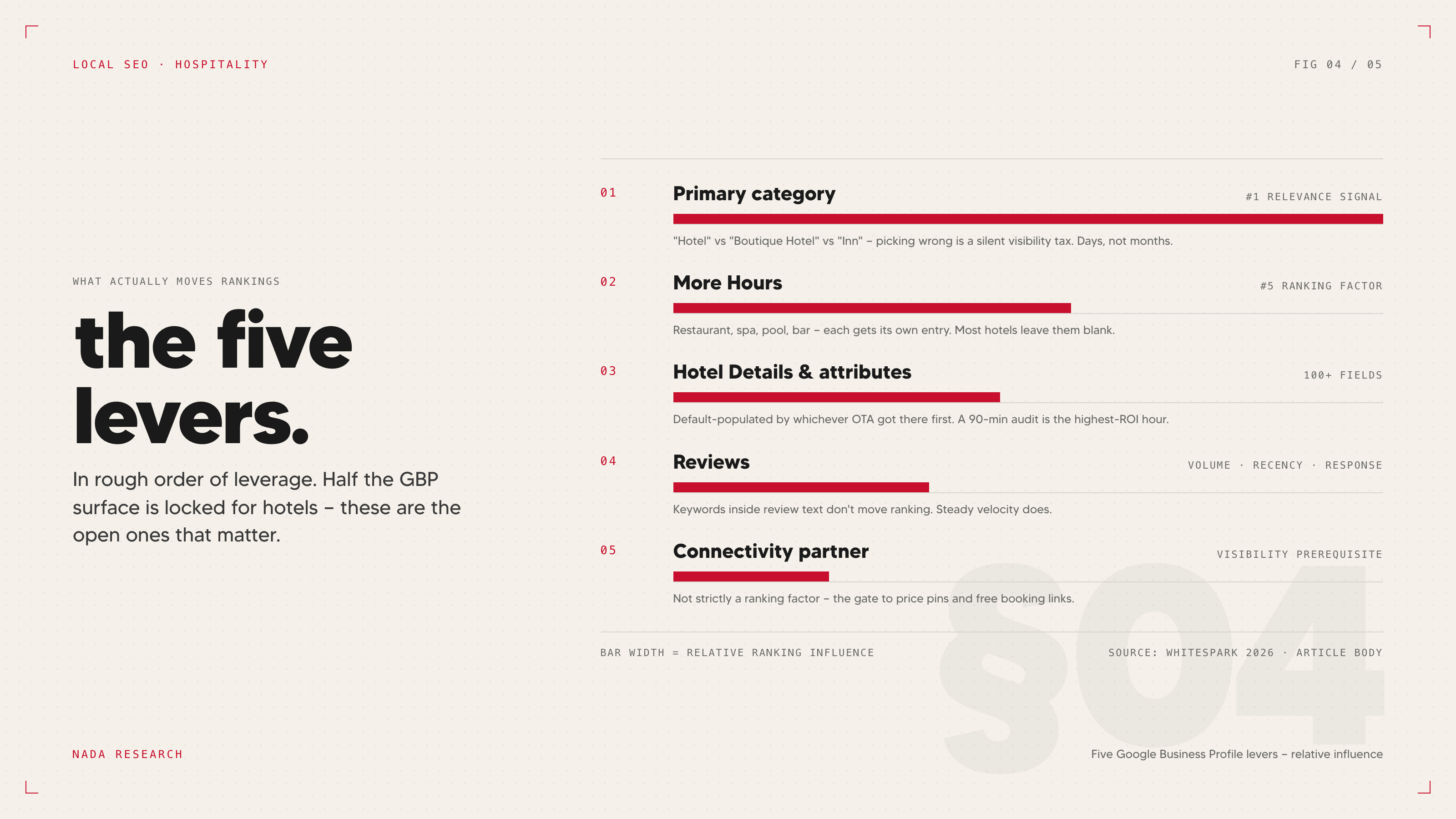
- Primary category. Whitespark's 2026 Local Search Ranking Factors survey ranks primary category as the #1 relevance signal for local pack visibility. Google offers at least 12 distinct lodging categories — Hotel, Boutique Hotel, Resort Hotel, Bed & Breakfast, Inn, Motel, Extended Stay Hotel, and regional variants like Holiday Park and Japanese Inn/Ryokan. Picking "Hotel" when you should be "Boutique Hotel" or "Inn" is a silent visibility tax: travelers who search for the more specific term filter you out of the result set entirely. Category changes can move rankings in days, not months. It is the fastest intervention available, and most independents have it set wrong.
- More Hours. Whitespark's 2026 survey identifies open-at-time-of-search as the 5th most influential ranking factor — more influential than the number of categories or the volume of native Google reviews with text. For hotels, this is non-obvious. Reception is 24/7, sure. But the restaurant isn't. The spa isn't. The pool isn't. The bar closes at midnight. Each of those wants its own More Hours entry, and the hotels that leave them blank lose visibility on evening and early-morning searches when travelers are deciding.
- Hotel Details and attributes. Google provides over a hundred attributes across amenities, sustainability, accessibility, food and drink, policies, and room features. By default, they're populated by whichever OTA got there first, and they're often outdated or wrong. They're also the primary relevance signal for amenity-modified queries — "pet-friendly hotel," "hotel with rooftop pool," "wheelchair-accessible boutique inn." A 90-minute audit of these fields is among the highest-ROI hours a hotel marketer can spend, and almost nobody does it.
- Reviews. Volume, recency, and response rate — in that order — affect ranking. Keywords inside review text do not, despite the Whitespark survey ranking them 9th; Sterling Sky's controlled testing on this is the most credible source on the topic and finds no effect (it's a contested call, but the testing tilts harder than the practitioner opinion). Hotels carry a higher review benchmark than other verticals: hotels average ~309 Google reviews across the industry; top-3 ranked local properties average 200+ reviews. A boutique with forty reviews is not closing that gap on volume alone. Steady velocity and high response rate close it on the signals that compound.
- Connectivity partner. This one isn't strictly a ranking factor — it's a visibility prerequisite. Without a certified connectivity partner feeding rates and availability to Google, your property shows on Google Maps as a blue dot rather than a price pin, and it's missing from the free booking link that Google introduced in 2021 to put direct rates alongside OTA rates in the knowledge panel. Most boutique PMSes — Cloudbeds, Mews, SiteMinder, WebRezPro, Hotelogix — are already certified. The five-minute check is whether the integration is turned on. The full mechanic, including the error states that silently kill the link, is in the free booking links post.
The deep tactical playbook for the first four levers — including the 12-category decoder and the ten things you've been told to do that testing has killed — is in the GBP levers playbook.
What's about to change
The Hotel Pack's mechanics have been stable since 2018 and the proximity rebalance since 2021. The next phase isn't another tweak to the pack — it's whether the pack continues to be the primary booking surface at all.
Travel queries saw a 381% increase in AI Overview presence between March 13 and 27, 2025 alone, per BrightEdge data. By early 2026, AI Overviews appeared in roughly a quarter of all US searches. The informational queries that used to send traffic to destination content — "best time to visit Savannah," "things to do in Taos with kids," "best neighborhoods in Lisbon" — are increasingly being answered before the user clicks anything. Hotels that used to capture upper-funnel demand through travel blog content are competing for AI Overview citation now, not for clicks.
In February 2026, Marriott and Google announced a partnership that lets travelers book Marriott properties directly through Google's AI Mode using natural language, bypassing OTA interfaces. Mark Fancourt's read on it in Hospitality Net is the right one: this is a signal, not a finished product. AI Mode adoption is still early. But the architectural direction is clear. Hotels that have a clean entity, structured data, a working connectivity partner, and unstructured citations on travel publications will be visible in this surface as it matures. Hotels that built their visibility on stuffed business names and a hundred directory citations will not be.
That's the honest framing. Not "here's what to do about AI" — anyone selling that as a finished playbook is overclaiming. The directional bet is on the same fundamentals that were already working in the Hotel Pack: clean signals, connectivity, real reviews, real citations. The hotels that built that base are positioned. The hotels that didn't have time to catch up.
If you've been doing hotel SEO as if it were dentist SEO, the question is which assumption to test first. The fastest read is your primary category — open your GBP, look at it, decide whether the name on the field actually matches what your property is. Then the GBP levers playbook for what to do next, or the free booking link audit if your map pin is currently a blue dot.
If after a 30-day audit you've cleaned all five levers and the rankings haven't moved, the constraint is structural — usually proximity (you're competing for queries the geometry won't let you win) or distribution (your rates aren't in the feed). Those are different problems, and they have their own posts.
Terms used in this post
- Hotel Pack
- The Google search module that displays three hotel results with map, ratings, and price pins for lodging queries. Powered by Google Travel infrastructure, not Google Maps. Replaced the Local Pack for hotel queries in 2018.
- Local Pack
- Google's standard three-result local business module for non-lodging queries — dentists, plumbers, restaurants. Includes phone, website link, directions, and hours.
- Vicinity update
- Google's late-2021 local algorithm rebalancing that increased the weight of physical proximity in rankings and tightened the ranking radius. Named by Joy Hawkins of Sterling Sky; later confirmed by Google.
- Google Business Profile (GBP)
- The free Google product hoteliers and other businesses use to manage their presence in Google Search and Maps. Formerly called Google My Business.
- Connectivity partner
- A certified third-party platform that pushes a hotel's rates and availability to Google in real time, enabling price pins on Maps and free booking links in the knowledge panel.
- Hotel Ads
- Google's paid metasearch product for hotel rates. The economic engine of Google's hotel surfaces, and the reason most "free" GBP features for hotels are restricted relative to other verticals.
- Prominence signals
- Ranking inputs based on a business's perceived importance — review volume, link authority, citation depth, editorial mentions. Distinct from proximity.
- Free booking link
- A direct-rate link Google added to hotel knowledge panels in 2021, which appears alongside OTA prices in the "Compare Prices" section. Requires a connected rate feed.
- Online travel agency (OTA)
- Third-party booking sites — Booking.com, Expedia, Hotels.com — that resell hotel inventory and dominate Google's hotel SERP.
- AI Overview / AI Mode
- Google's generative-AI search surfaces that summarize answers above traditional results. AI Overviews appear above blue links; AI Mode is a fuller conversational interface. ---
Frequently asked questions
-
What's the difference between the Hotel Pack and the Local Pack?
The Local Pack is Google's general local-business module — three results with phone, website, directions, and hours, surfacing for queries like "dentist near me." The Hotel Pack replaced it for lodging queries in 2018 and runs on different infrastructure (Google Travel, not Google Maps). The Hotel Pack hides the website link and phone number, surfaces price pins fed by OTA rate feeds, and routes users to a "Compare Prices" panel that shows OTAs before the hotel's own rate. Half the standard GBP optimization checklist doesn't apply.
-
When did Google separate hotels from local search results?
In 2018. Google quietly stopped surfacing localized organic results for queries combining "hotel" with a location, replacing the standard Local Pack with the Hotel Pack module powered by Google Travel. The change was documented by Tim Capper at BrightLocal but rarely acknowledged in mainstream hotel SEO advice, which is why most published GBP guidance for hoteliers is structurally outdated.
-
What was the Google Vicinity update and how did it affect hotels?
The Vicinity update was Google's late-2021 rebalancing of the local search algorithm — the largest change since Possum in 2016. It increased the weight of physical proximity in local rankings and de-weighted keyword-stuffed business names. For hotels, it tightened the ranking radius dramatically: properties that had been ranking city-wide from a single location lost that spillover visibility, while neighborhood- and landmark-specific queries became more winnable for independents. Proximity now accounts for roughly 55% of local ranking decisions per the Whitespark 2026 survey.
-
Do hotels need a connectivity partner to rank on Google?
A connectivity partner isn't a direct ranking factor, but without one, your property appears on Google Maps as a blue dot rather than a price pin and is excluded from the free booking links Google introduced in 2021. That eliminates a major direct-booking surface. Most boutique property management systems — Cloudbeds, Mews, SiteMinder, WebRezPro, Hotelogix — are already certified; the question is whether the integration is turned on. The five-minute audit is whether your property currently shows a price next to it on Google.
-
Why can't hotels use Google Business Profile Posts and Offers?
Google has restricted promotional features for the lodging category. Hotels can't run Offers, can't add Products, and Posts are limited to informational content like renovations or events with no promotional language. Profile "highlights" are auto-generated from review text and traveler-segment data — hoteliers can't edit them. Attributes are auto-populated by whichever OTA fed Google first and are frequently wrong until manually overridden. The architectural read is that Google's hotel surfaces are calibrated around its Hotel Ads ad-revenue product, not around hoteliers' merchandising needs.
-
What's the most important Google Business Profile setting for a hotel?
Primary category — by a wide margin. Google offers at least 12 distinct lodging categories (Hotel, Boutique Hotel, Resort Hotel, Bed & Breakfast, Inn, Motel, Extended Stay Hotel, and regional variants). Picking "Hotel" when the property is actually a boutique hotel or inn filters the property out of more specific search results entirely. The Whitespark 2026 survey ranks primary category as the #1 relevance signal for local pack visibility, and category changes can move rankings within days. Most independent hotels have it set wrong.